Carton Milk vs. Bottle Milk: A Scientific Comparison of Quality, Safety, Shelf Life, and Consumer Impact
Milk is one of the most widely consumed food products worldwide, valued not only for its nutritional richness but also for its functional role in human diets across all age groups. However, while consumers often focus on fat percentage, brand reputation, or freshness claims, one critical factor is frequently underestimated: packaging format.
In today’s dairy markets, milk is commonly available in two primary forms: carton-packaged milk and bottle-packaged milk. At first glance, these two products may appear identical, as both originate from the same raw material. Nevertheless, from a scientific and technological perspective, packaging type significantly influences microbiological safety, nutritional stability, shelf life, sensory characteristics, logistics efficiency, and environmental sustainability.
Therefore, this article provides a comprehensive scientific comparison between carton milk and bottle milk. By examining processing technologies, packaging materials, chemical stability, and consumer safety, we aim to clarify the real differences and correct common misconceptions.
1. Why Milk Packaging Matters More Than Consumers Think
To begin with, milk is a highly perishable biological fluid. Due to its composition—water, lactose, proteins, lipids, vitamins, and minerals—it creates an ideal environment for microbial growth. Consequently, without appropriate preservation methods, raw milk can spoil rapidly.
For this reason, packaging should not be viewed as a passive container. Instead, it must be understood as a critical component of the food preservation system. In fact, packaging interacts directly with processing methods, storage conditions, and distribution logistics.
Moreover, modern packaging must protect milk from:
- Microbial contamination
- Oxygen exposure
- Light-induced oxidation
- Temperature fluctuations
As a result, differences in packaging design directly translate into differences in product stability and safety.
2. Carton Milk: Aseptic Packaging and UHT Technology
2.1 Structure of Aseptic Carton Packaging
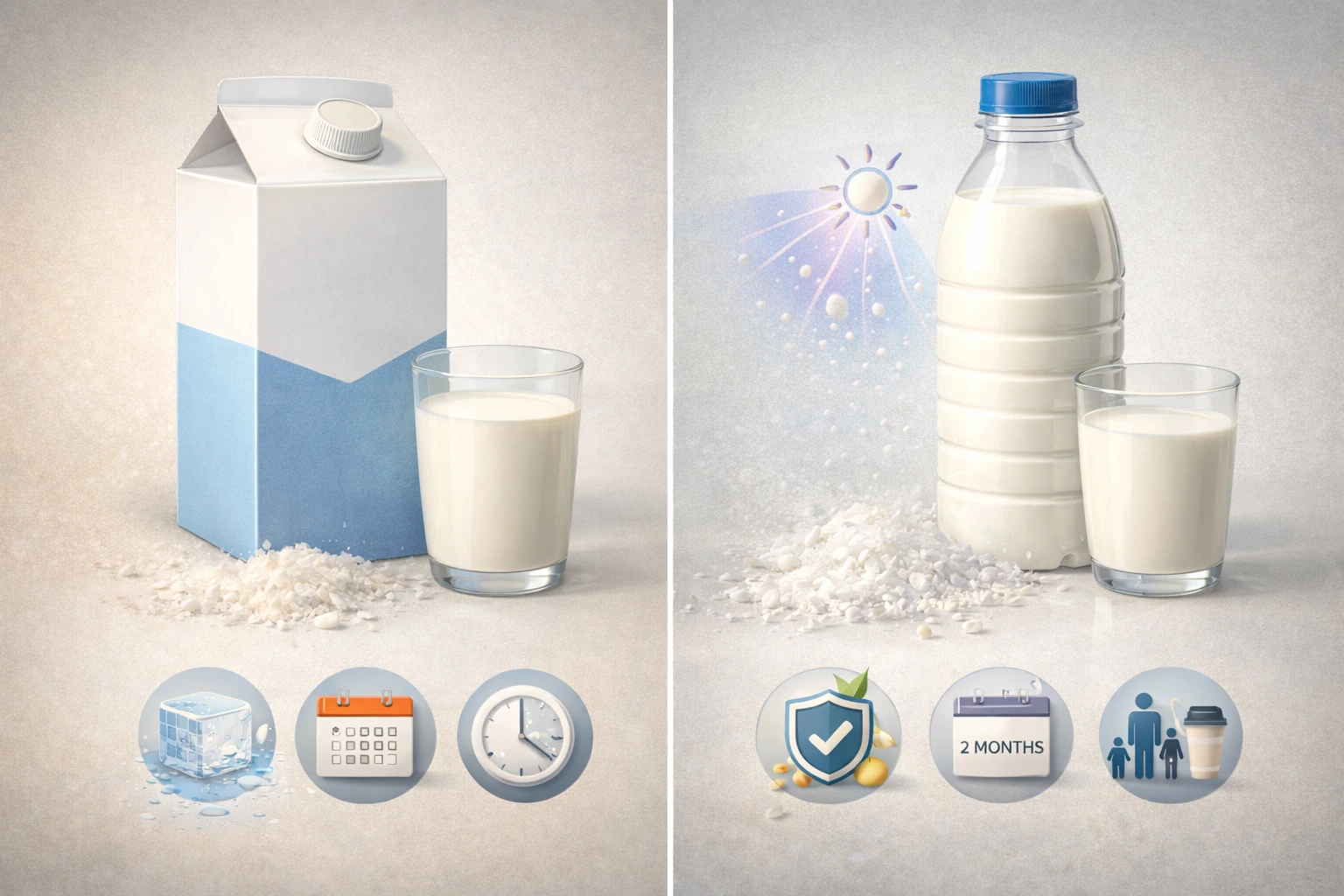
Carton milk is typically packed in aseptic multilayer cartons, most commonly used for UHT-treated milk. These cartons are carefully engineered to provide multiple protective barriers.
Specifically, a standard aseptic carton consists of:
- Paperboard for mechanical strength
- Polyethylene layers for moisture resistance and heat sealing
- Aluminum foil as a barrier against oxygen, light, and external contaminants
As a result of this multilayer structure, carton packaging creates a near-sterile internal environment, which is essential for long shelf life.
2.2 UHT Processing: The Scientific Basis
In addition to packaging, carton milk relies on Ultra-High Temperature (UHT) processing. During this process, milk is heated to approximately 135–150°C for a few seconds, followed by rapid cooling and aseptic filling.
Therefore, UHT treatment:
- Eliminates pathogenic and spoilage microorganisms
- Inactivates enzymes responsible for degradation
- Minimizes microbial regrowth during storage
Consequently, unopened carton milk can remain shelf-stable for 6 to 9 months without refrigeration.
3. Bottle Milk: Pasteurization and Refrigerated Distribution
In contrast, bottle milk is usually associated with pasteurized or ESL (Extended Shelf Life) milk and is packaged in either plastic or glass bottles.
3.1 Packaging Materials Used for Bottle Milk
Bottle milk packaging typically includes:
- HDPE or PET plastic bottles, which are lightweight and economical
- Glass bottles, which are chemically inert and offer excellent barrier properties
However, although glass provides superior protection against oxygen and moisture, it is heavier, more fragile, and more energy-intensive to transport. Plastic bottles, on the other hand, are more practical but offer limited protection against light.
3.2 Pasteurization and ESL Technologies
Bottle milk is most often treated using:
- HTST pasteurization (72–75°C for 15–20 seconds)
- Or ESL methods combining microfiltration with mild heat treatment
As a result, pasteurized milk retains a fresher taste. However, because not all microorganisms are destroyed, continuous refrigeration is mandatory.
Therefore, shelf life is significantly shorter, typically ranging from:
- 3–14 days for pasteurized milk
- 20–40 days for ESL milk
4. Microbiological Safety: A Critical Comparison
From a microbiological standpoint, carton milk and bottle milk differ substantially.
Carton Milk (UHT)
- Virtually sterile before opening
- Extremely low microbial count
- Minimal spoilage risk if packaging remains intact
Bottle Milk (Pasteurized)
- Reduced but present microbial population
- Vulnerable to post-processing contamination
- Highly sensitive to cold-chain failures
Therefore, in regions with unstable refrigeration infrastructure, carton milk provides significantly higher safety margins.
5. Nutritional Stability and Chemical Changes
5.1 Proteins and Fats
One widespread belief is that UHT milk is nutritionally inferior. However, scientific evidence does not fully support this claim.
In fact:
- Casein proteins remain structurally stable during UHT treatment
- Whey proteins may undergo minor denaturation, but nutritional value is preserved
- Milk fat globules remain functionally intact
Thus, macronutrient composition remains largely unchanged.
5.2 Vitamins and Oxidation Effects
Although heat-sensitive vitamins such as Vitamin C and certain B vitamins may decrease slightly during UHT processing, milk is not a major dietary source of these nutrients.
On the other hand, bottle milk exposed to light—especially in transparent packaging—may experience:
- Riboflavin (Vitamin B2) degradation
- Photooxidation of fats, leading to off-flavors
Consequently, nutritional differences between carton and bottle milk are generally minor and not clinically significant.
6. Shelf Life and Supply Chain Efficiency
Shelf life plays a crucial role not only in consumer convenience but also in logistics efficiency.
Carton Milk
- Long shelf life without refrigeration
- Lower risk of spoilage during transport
- Ideal for long-distance distribution
Bottle Milk
- Short shelf life
- Requires uninterrupted cold chain
- Higher spoilage risk during handling
Therefore, from a supply chain and export perspective, carton milk offers greater operational flexibility and reduced waste.
7. Sensory Properties: Taste, Aroma, and Consumer Preference
Taste perception is often the decisive factor for consumers.
Bottle Milk
- Fresher sensory profile
- Higher retention of volatile aroma compounds
- Often preferred in local markets
Carton Milk
- Slight “cooked” flavor due to Maillard reactions
- Stable and consistent taste over time
Importantly, taste differences are sensory rather than safety-related.
8. Environmental and Sustainability Considerations
From an environmental perspective, packaging sustainability has become increasingly important.
Carton Packaging
- Lightweight
- Lower transportation emissions
- Recycling depends on infrastructure
Bottle Packaging
- Plastic contributes to microplastic pollution
- Glass is recyclable but energy-intensive
Therefore, sustainability outcomes depend more on waste management systems than packaging type alone.
9. Consumer Safety After Opening
Regardless of packaging type:
- Milk becomes vulnerable after opening
- Refrigeration is essential
- Consumption within 2–5 days is recommended
Thus, improper handling—not packaging—is the leading cause of spoilage.
10. Final Evaluation: Which Packaging Is Better?
Carton Milk Is Preferable When:
- Refrigeration is limited
- Long shelf life is required
- Export and logistics stability are priorities
Bottle Milk Is Preferable When:
- Cold chain is reliable
- Fresh taste is prioritized
- Local distribution is available
Final Conclusion
In conclusion, the difference between carton milk and bottle milk is not a matter of quality versus inferiority. Rather, it is a question of processing technology, packaging science, and intended use.
Scientifically speaking:
- Carton (UHT) milk offers maximum microbiological safety and shelf stability
- Bottle (pasteurized) milk offers sensory freshness with shorter shelf life
Ultimately, understanding these differences empowers consumers to make informed, science-based decisions, while enabling producers to choose the most effective packaging strategy for their markets.
In modern dairy systems, packaging is not separate from the product—it is part of the product itself.