Milk Powder vs Fresh Milk in Industrial Food Production
Which Ingredient Delivers Better Performance, Stability, and Cost Efficiency?
In industrial food production, selecting the right dairy ingredient is not simply a matter of preference. Instead, it is a strategic decision that directly influences product quality, processing efficiency, shelf life, logistics, and cost control. Among all dairy options, milk powder and fresh liquid milk remain the most widely used raw materials. However, despite having the same origin, their performance in large-scale food manufacturing differs significantly.
For this reason, understanding the practical differences between milk powder and fresh milk is essential for manufacturers operating in bakery, confectionery, beverages, dairy products, ready meals, and nutritional formulations.
This article offers a comprehensive comparison of milk powder vs fresh milk in industrial food production, with a focus on functionality, economics, processing stability, and real manufacturing requirements.
Understanding the Basics: What Differentiates Milk Powder from Fresh Milk?
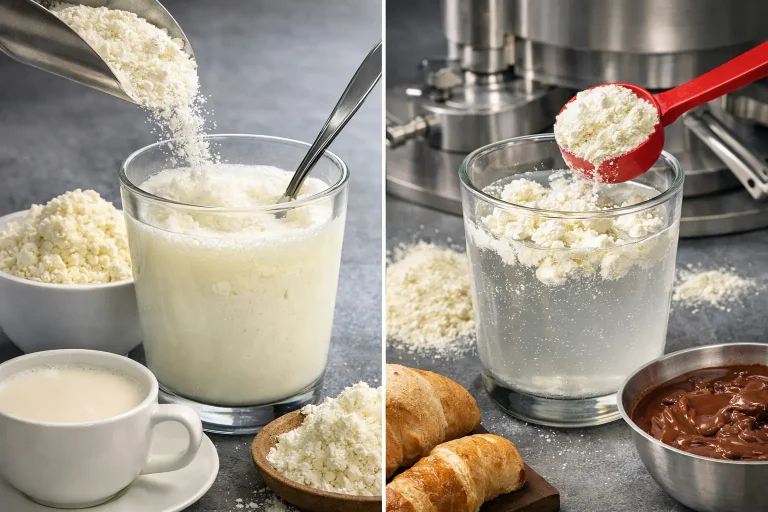
Fresh milk is a perishable liquid that contains approximately 87% water and 13% milk solids, including proteins, lactose, fats, minerals, and vitamins. In contrast, milk powder is produced by removing most of this water through evaporation and spray drying. As a result, it becomes a concentrated and shelf-stable dairy ingredient.
Although the nutritional components are largely preserved, the removal of water fundamentally changes how milk powder behaves in industrial processing. Therefore, these two ingredients serve different purposes rather than acting as direct substitutes.
Shelf Life and Storage Stability
One of the most decisive differences between milk powder and fresh milk is shelf life.
Shelf Life of Fresh Milk
Fresh milk typically offers a shelf life of 5 to 10 days under refrigeration, depending on pasteurization or UHT treatment. Consequently, it requires continuous cold-chain logistics, strict hygiene control, and rapid processing. Even minor temperature fluctuations may lead to spoilage, off-flavors, or microbial growth.
Shelf Life of Milk Powder
Milk powder, on the other hand, can be stored for 12 to 24 months under proper conditions. Because it contains very low moisture, microbial activity is minimized. As a result, milk powder provides long-term storage stability, eliminates refrigeration needs, and significantly reduces spoilage risk.
For industrial producers, this stability translates into better inventory management, lower waste, and uninterrupted production.
Transportation and Logistics Efficiency
Logistics represent a major cost factor in industrial food production. From this perspective, milk powder clearly offers advantages.
Transporting fresh milk involves moving large volumes of water. Therefore, logistics costs increase due to refrigerated tankers, higher fuel consumption, and limited transport distance. In export-oriented supply chains, fresh milk quickly becomes impractical.
Milk powder, by comparison, is lightweight, compact, and easy to handle. Because only the functional milk solids are transported, shipping costs decrease substantially. Moreover, milk powder enables easier international trade, lower carbon emissions, and simplified storage.
Production Consistency and Year-Round Availability
Industrial manufacturers depend on consistent raw material quality.
Fresh milk quality can fluctuate due to seasonal changes, animal feed variations, and regional conditions. As a consequence, protein, fat, and solids levels may vary throughout the year, potentially affecting formulation stability.
Milk powder, however, is produced under controlled industrial conditions and standardized for protein content, moisture, solubility, and heat stability. Therefore, manufacturers achieve predictable performance regardless of season or origin.
Functional Performance in Industrial Applications
Functionality is where milk powder truly distinguishes itself.
Milk powder offers controlled solubility, water-binding capacity, emulsification support, heat stability, and texture enhancement. Additionally, different heat classes (Low Heat, Medium Heat, High Heat) allow precise matching with processing requirements.
Fresh milk, while nutritionally complete, provides limited functional control. Its high water content can complicate viscosity management and heat processing. Thus, additional processing steps are often required when fresh milk is used.
Processing Flexibility and Formulation Control
Modern food production demands flexibility and precision.
Milk powder allows manufacturers to reconstitute milk at any desired concentration. For example, higher solids can be used for ice cream, while lower solids suit beverages. Protein levels can also be adjusted easily for nutritional products.
Fresh milk does not offer this flexibility without evaporation or blending. Consequently, milk powder simplifies formulation design and reduces processing complexity.
Cost Efficiency and Price Stability
Cost predictability plays a critical role in industrial operations.
Fresh milk prices often fluctuate due to seasonal supply, feed costs, and dairy policies. In addition, spoilage losses and cold-chain logistics increase total expenses.
Milk powder, by contrast, provides longer procurement planning, reduced losses, and more stable pricing. As a result, manufacturers gain better financial control, especially in price-sensitive markets.
Food Safety and Microbiological Control
Food safety regulations continue to tighten worldwide.
Milk powder production involves heat treatment and low-moisture conditions, which significantly reduce microbiological risk. Therefore, it is easier to manage under HACCP, ISO, and GMP systems.
Fresh milk remains a higher-risk ingredient that requires constant monitoring. From a risk-management standpoint, milk powder offers superior control.
Application-Specific Comparison
In the bakery industry, milk powder improves dough strength, crust color, and moisture retention. Fresh milk, however, introduces excess water.
In confectionery and chocolate manufacturing, milk powder allows precise control over solids and fat. Thus, it is preferred over fresh milk.
In beverages, both ingredients are used, but milk powder ensures consistency and longer shelf life. Similarly, in ice cream production, milk powder enables better texture and solids control.
Sustainability and Environmental Impact
Sustainability has become an important purchasing criterion.
Milk powder contributes positively by reducing food waste, lowering transportation emissions, and supporting efficient global distribution. Meanwhile, fresh milk remains suitable mainly for local supply chains.
Pros and Cons of Milk Powder vs Fresh Milk :
From an industrial perspective, both milk powder and fresh milk offer clear advantages as well as practical limitations. Therefore, choosing between them depends more on production strategy than on nutritional value alone.
Advantages of Milk Powder
First of all, milk powder provides excellent shelf stability. Because moisture has been removed, it can be stored for long periods without refrigeration, which significantly reduces storage and transportation costs. In addition, milk powder allows precise control over formulation, since fat, protein, and solids can be adjusted accurately during processing.
Moreover, milk powder ensures consistent quality throughout the year. Unlike fresh milk, it is not affected by seasonal fluctuations in supply, fat content, or microbiological variability. As a result, manufacturers benefit from predictable performance, reduced production risk, and improved batch-to-batch consistency.
Furthermore, milk powder simplifies logistics. It is easier to transport, handle, and store, especially in large-scale factories or export-oriented operations. Consequently, many industrial producers prefer milk powder for bakery, confectionery, beverages, and recombined dairy products.
Limitations of Milk Powder
However, milk powder is not without drawbacks. In some applications, it may lack the fresh sensory profile that liquid milk naturally provides. Therefore, additional flavor adjustments may be required in premium or fresh-positioned products.
Additionally, improper reconstitution or incorrect heat treatment selection can lead to solubility issues or functional instability. For this reason, technical knowledge is essential when using milk powder in complex formulations.
Advantages of Fresh Milk
On the other hand, fresh milk offers a natural and authentic image that appeals strongly to consumers, particularly in fresh dairy products. Because it requires minimal processing, it preserves a traditional perception of quality and freshness.
Moreover, fresh milk performs well in short production cycles where immediate processing is possible. In local and small-scale operations, this can simplify formulation and reduce reliance on rehydration steps.
Limitations of Fresh Milk
Nevertheless, fresh milk presents several industrial challenges. Most importantly, its short shelf life demands continuous cold-chain management, which increases operational costs. In addition, variability in composition can affect texture, yield, and consistency in large-scale production.
Furthermore, fresh milk is less suitable for long-distance transportation and export-oriented manufacturing. As a result, its use becomes limited in factories that require high production stability and logistical flexibility.
Practical Summary
In conclusion, milk powder offers superior stability, cost efficiency, and formulation control, making it the preferred choice for industrial food production. Meanwhile, fresh milk remains valuable in products where freshness, local sourcing, and short processing cycles are critical. Ultimately, the optimal choice depends on production scale, target market, and technical requirements rather than on one ingredient being inherently better than the other.
Final Verdict: Milk Powder vs Fresh Milk
Milk powder and fresh milk are not direct competitors. Instead, they serve different roles.
Fresh milk suits local, short-cycle production. However, milk powder dominates industrial food manufacturing due to its stability, flexibility, and cost efficiency.
Conclusion
In modern industrial food production, milk powder has become indispensable. Its long shelf life, standardized quality, functional versatility, and economic advantages make it the preferred dairy ingredient for large-scale manufacturers.
Ultimately, the right choice depends on production scale and supply chain structure. Nevertheless, for most industrial applications, milk powder delivers superior long-term value.