Buttermilk Powder Explained
Functional Benefits, Applications, and Why It Matters in Modern Food Formulation
In today’s food industry, manufacturers are no longer looking at dairy ingredients only as sources of nutrition. Instead, they evaluate them as functional tools that influence texture, flavor, processing efficiency, stability, and cost. Among these ingredients, buttermilk powder holds a unique position. Although often misunderstood or underestimated, This powder offers a combination of functional, sensory, and economic advantages that make it highly valuable across a wide range of applications.
This article provides a complete, practical, and market-driven guide to buttermilk powder—what it is, how it is produced, how it differs from other milk powders, and why it continues to gain importance in modern food formulation.
What Is Buttermilk Powder?
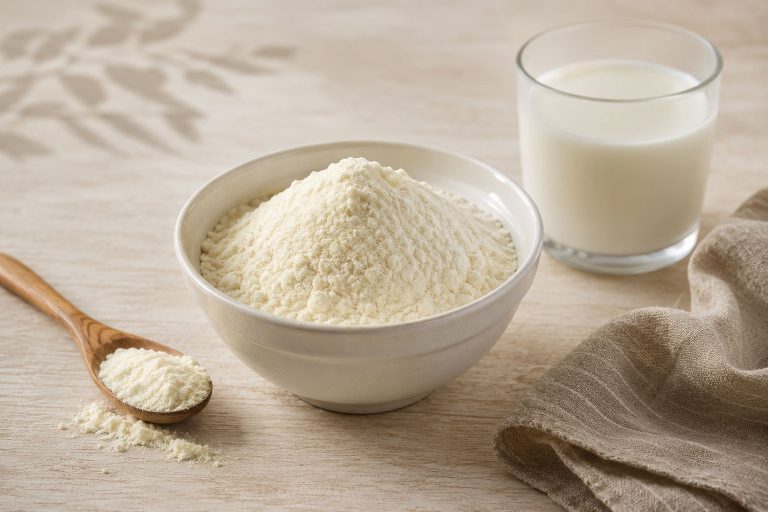
Buttermilk powder is a dried dairy ingredient produced by removing water from liquid buttermilk, which is a by-product of butter manufacturing. Unlike traditional milk powder, this product contains a higher proportion of milk fat globule membrane (MFGM) components, phospholipids, and surface-active proteins.
These components give buttermilk powder distinctive functional properties that are not typically found in skim milk powder (SMP) or whole milk powder (WMP).
In simple terms, this powder is not just “milk powder with less fat.” It is a functionally enhanced dairy ingredient with unique emulsifying and flavor-building characteristics.
How Buttermilk Powder Is Produced
Understanding the production process helps explain why buttermilk powder behaves differently from standard milk powders.
- Butter Production
Cream is churned to separate butterfat from the aqueous phase. The liquid phase left behind is buttermilk. - Concentration
The liquid powder is concentrated to reduce water content while preserving functional components. - Heat Treatment (Controlled)
Heat is applied carefully to ensure microbiological safety while maintaining protein functionality. - Spray Drying
The concentrated buttermilk is spray-dried to produce a stable powder with good shelf life.
The result is a powder rich in lactose, proteins, minerals, and phospholipids—especially MFGM components that enhance emulsification and mouthfeel.
Key Nutritional and Functional Composition
Buttermilk powder typically contains:
- Moderate protein levels (lower than MPC or WPC)
- High lactose content
- Low to moderate fat
- Natural emulsifiers (phospholipids)
- Milk minerals (calcium, phosphorus)
However, its true value lies in functionality rather than protein percentage.
Functional Advantages of Buttermilk Powder
1. Natural Emulsification
One of the most important benefits of buttermilk powder is its excellent emulsifying ability. The phospholipids and MFGM proteins help stabilize oil-in-water emulsions naturally.
This makes this powder particularly effective in:
- Sauces and dressings
- Bakery fat systems
- Processed cheese
- Recombined dairy products
In many formulations, it can reduce the need for synthetic emulsifiers.
2. Enhanced Mouthfeel and Creaminess
Buttermilk powder contributes a rich, creamy mouthfeel, even in reduced-fat formulations. This property is especially valuable in cost-sensitive or fat-reduced products where sensory quality must be preserved.
Applications include:
- Ice cream and frozen desserts
- Dairy beverages
- Bakery fillings
- Ready-to-eat meals
3. Flavor Development
Buttermilk powder provides a mild, pleasant dairy flavor with subtle buttery notes. Unlike some milk powders that can taste flat or cooked, this powder enhances overall flavor complexity.
As a result, it is often used to:
- Improve flavor in baked goods
- Enhance savory dairy systems
- Support clean-label formulations
4. Water Binding and Texture Control
Thanks to its protein and phospholipid structure, This powder improves water retention and texture stability. This helps reduce dryness, syneresis, and texture breakdown during storage.
Comparison with Other Milk Powders
Buttermilk Powder vs Skim Milk Powder (SMP)
| Aspect | Buttermilk Powder | SMP |
|---|---|---|
| Emulsification | Strong | Limited |
| Flavor | Rich, creamy | Neutral |
| Fat content | Low–moderate | Very low |
| Functional role | Texture & flavor | Structure & solids |
SMP is ideal for general dairy solids, while this powder adds functional depth.
Buttermilk Powder vs Whole Milk Powder (WMP)
| Aspect | Buttermilk Powder | WMP |
|---|---|---|
| Fat source | MFGM-rich | Milk fat |
| Emulsifying power | High | Moderate |
| Cost efficiency | Often better | Higher fat cost |
| Flavor profile | Buttery, complex | Full dairy |
In many formulations, This powder can partially replace WMP while maintaining creaminess at a lower cost.
Industrial Applications of Buttermilk Powder
1. Bakery Industry
Buttermilk powder is widely used in:
- Bread and rolls
- Cakes and muffins
- Biscuits and crackers
Benefits include improved browning, softer crumb, better moisture retention, and enhanced flavor.
2. Processed Cheese and Analogues
In cheese sauces and processed cheese products, buttermilk powder improves emulsification and meltability while contributing to a smooth texture.
3. Ice Cream and Frozen Desserts
Its phospholipids support fat dispersion and help control ice crystal formation, resulting in:
- Creamier texture
- Better overrun
- Improved freeze–thaw stability
4. Sauces, Soups, and Ready Meals
Buttermilk powder enhances viscosity, mouthfeel, and flavor in savory applications without heavy reliance on starches or gums.
5. Recombined Dairy Products
In UHT milk drinks, creamers, and dairy beverages, it supports emulsion stability and sensory quality.
Economic and Market Advantages
From a commercial perspective, buttermilk powder offers:
- Cost efficiency compared to high-fat dairy ingredients
- Multifunctionality, reducing ingredient complexity
- Clean-label potential as a natural dairy component
For manufacturers facing rising raw material costs, this powder provides a way to optimize formulation without sacrificing quality.
Clean Label and Consumer Perception
Consumers increasingly favor familiar and natural ingredients. Buttermilk powder benefits from:
- Strong dairy identity
- No chemical modification
- Familiar consumer perception
When declared properly, it fits well into clean-label strategies, especially in bakery and dairy categories.
Quality Considerations When Sourcing Buttermilk Powder
Buyers should evaluate:
- Moisture content
- Microbiological quality
- Solubility and dispersibility
- Flavor profile
- Particle size and flowability
Consistent quality is essential, as variations can affect emulsification and sensory performance.
Common Misconceptions About Buttermilk Powder
❌ “It’s just a by-product.”
✔️ In reality, it is a functional ingredient with unique properties.
❌ “It’s nutritionally weak.”
✔️ While not a protein concentrate, its functional value is high.
❌ “It’s interchangeable with SMP.”
✔️ Substitution without reformulation can lead to performance differences.
Strategic Use in Formulation
The most successful manufacturers do not use buttermilk powder as a replacement ingredient—but as a strategic component that improves performance, reduces cost, and enhances product quality.
Buttermilk Powder Wholesale and Supply Considerations
For manufacturers sourcing buttermilk powder wholesale, consistency, functionality, and supplier reliability are just as important as price. In large-scale food production, wholesale buttermilk powder must deliver stable emulsifying performance, predictable flavor, and uniform quality across batches. Tejarat Chavosh Arian, as the producer and supplier of the Shahdoosh dairy ingredient brand, focuses on providing This powder that meets industrial standards for moisture control, phospholipid content, solubility, and microbiological safety. By working with a reliable buttermilk powder wholesale supplier such as Shahdoosh, food manufacturers can optimize formulation costs while maintaining sensory quality and process efficiency across bakery, dairy, and ready-meal applications.
Final Thoughts
Buttermilk powder is one of the most undervalued dairy ingredients in modern food formulation. Its unique emulsifying power, flavor contribution, and texture enhancement make it a powerful tool across bakery, dairy, frozen desserts, and savory applications.
In a market where efficiency, functionality, and clean labeling are increasingly important, this powder offers a smart balance between performance and cost. Manufacturers who understand its real capabilities can unlock significant formulation advantages.
In today’s competitive food industry, success comes not from using more ingredients—but from using the right ingredient in the right way.