Impact of Milk Powder Particle Size on Solubility and Processing Performance
Why Some Milk Powders Dissolve Instantly While Others Form Lumps
Milk powder is one of the most versatile dairy ingredients in industrial food production. It is widely used in beverages, bakery products, confectionery, ice cream, nutritional formulations, and recombined dairy products. However, not all milk powders behave the same way during processing. One of the most overlooked yet critical factors influencing performance is particle size.
Although protein content, fat level, and heat treatment often receive the most attention, particle size distribution plays an equally decisive role in determining solubility, dispersibility, flowability, and overall processing efficiency. In practice, it explains why some milk powders dissolve instantly while others form stubborn lumps or sink at the bottom of the tank.
This article explores how milk powder particle size affects solubility and industrial performance, why agglomeration matters, and how manufacturers can select the right powder for applications such as instant beverages, coffee, and recombined milk.
Understanding Milk Powder Particle Size
Milk powder particle size refers to the average diameter of individual powder particles, usually measured in micrometers (µm). In reality, milk powder is not made of particles with a single size. Instead, it contains a particle size distribution, meaning a range of small, medium, and large particles.
Typically:
- Fine particles: < 100 µm
- Medium particles: 100–250 µm
- Coarse or agglomerated particles: > 250 µm
This distribution directly affects how powder interacts with water, air, and processing equipment.
At first glance, finer particles may seem preferable because they offer a higher surface area. However, in liquid applications, this assumption often leads to unexpected problems.
Why Particle Size Directly Affects Solubility
Solubility in industrial terms is not only about whether a powder can dissolve chemically. Instead, it involves four practical stages:
- Wetting – how easily water penetrates the powder
- Sinking – whether particles sink or float
- Dispersion – how well particles separate in liquid
- Dissolution – how completely solids dissolve
Particle size influences each of these stages.
Fine Particles and Poor Wetting
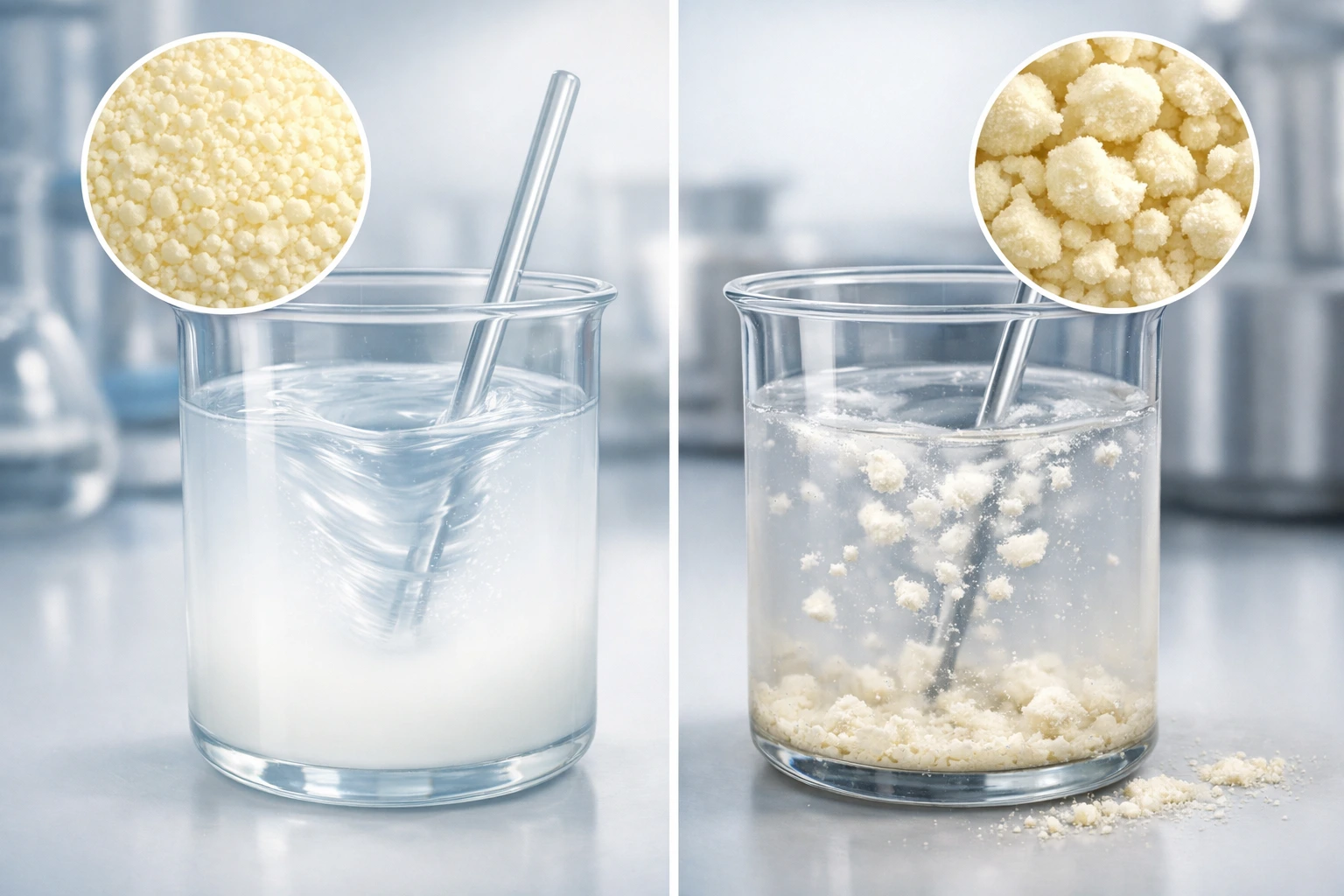
Very fine milk powder particles tend to trap air on their surface. As a result, when added to water, they often float instead of sinking. Consequently, they form dry clumps on the surface, commonly referred to as “fish eyes.”
In addition, fine powders have strong inter-particle forces. These forces cause particles to stick together, making dispersion difficult even with mechanical agitation.
Larger Particles and Improved Hydration
By contrast, larger or agglomerated particles contain internal pores. These pores allow water to penetrate quickly, displacing trapped air. As a result, the powder wets faster, sinks more easily, and disperses uniformly.
Therefore, larger particle size often improves practical solubility, even though it reduces surface area.
Agglomeration: The Key to Instant Solubility
Agglomeration is a controlled process in which fine milk powder particles are bound together to form larger, porous clusters. Importantly, agglomeration does not change the chemical composition of milk powder. Instead, it modifies its physical structure.
How Agglomeration Works
During spray drying or post-drying processing, small particles are lightly moistened and then re-dried so they adhere to one another. This creates:
- Larger particle size
- Higher porosity
- Lower bulk density
- Improved flowability
As a result, agglomerated milk powder behaves very differently from standard powder during reconstitution.
Agglomerated vs Non-Agglomerated Powder
Non-agglomerated milk powder:
- Dissolves slowly
- Tends to form lumps
- Requires high shear mixing
Agglomerated milk powder:
- Wets instantly
- Disperses uniformly
- Dissolves with minimal stirring
For this reason, agglomeration is essential for instant milk powders, coffee creamers, and beverage mixes.
Particle Size and Processing Performance in Industry
Beyond solubility, particle size has a major impact on industrial processing efficiency.
Flowability and Handling
Powders with very fine particles often show poor flow characteristics. They may bridge in silos, stick to hopper walls, or cause inconsistent dosing.
On the other hand, milk powders with optimized particle size flow smoothly through conveyors, feeders, and packaging lines. This reduces downtime, improves accuracy, and minimizes product loss.
Dusting and Workplace Safety
Fine powders generate dust during handling. This not only causes material loss but also increases explosion risk and hygiene concerns.
Larger, agglomerated particles significantly reduce dust formation, creating a safer and cleaner processing environment.
Mixing and Rehydration Time
In high-volume operations, rehydration speed directly affects production capacity. Powders that dissolve slowly increase mixing time, energy consumption, and processing costs.
Because agglomerated powders hydrate faster, they support shorter batch cycles and more efficient plant operation.
Importance in Instant Beverages and Coffee Applications
Instant beverages represent one of the most demanding applications for milk powder.
Instant Drinks and Nutritional Beverages
In instant drink mixes, consumers expect:
- Rapid dissolution
- No visible lumps
- Smooth mouthfeel
If particle size is too fine, the powder floats and clumps. Conversely, if particles are too large and poorly designed, incomplete dissolution may occur.
Therefore, manufacturers rely on carefully agglomerated milk powder to achieve consistent instant performance.
Coffee Creamers and Vending Machines
Coffee applications present additional challenges. Milk powder must dissolve quickly in hot water, often under low agitation conditions.
Agglomerated powders with controlled particle size ensure:
- Fast wetting
- Uniform dispersion
- Stable foam and mouthfeel
Without proper particle size control, even high-quality milk powder may perform poorly in coffee systems.
Role in Recombined Milk Production
Recombined milk production depends heavily on efficient reconstitution.
Rehydration Efficiency
In recombined milk plants, milk powder is dissolved in large tanks to recreate liquid milk. If particle size is poorly optimized:
- Mixing time increases
- Energy consumption rises
- Incomplete hydration may occur
Agglomerated milk powder reduces these issues by improving water penetration and dissolution speed.
Product Consistency
Uneven dissolution can lead to protein aggregation, sedimentation, or inconsistent viscosity. Over time, this affects final product quality and consumer acceptance.
Thus, selecting the right particle size is essential for stable, uniform recombined milk.
Particle Size, Heat Treatment, and Functional Balance
Particle size does not act alone. Instead, it interacts with heat treatment and protein structure.
Low Heat milk powders, for example, often exhibit excellent solubility. However, if particle size is too fine, even Low Heat powders may show poor wetting behavior.
Similarly, High Heat milk powders benefit greatly from agglomeration because protein denaturation can reduce natural solubility. Larger, porous particles help compensate for this effect.
Therefore, optimal performance requires balancing heat treatment and particle size, not focusing on either factor in isolation.
Measuring Particle Size in Milk Powder
Manufacturers use several methods to evaluate particle size:
- Laser diffraction analysis
- Sieve analysis
- Bulk density measurement
In addition, functional tests such as solubility index, dispersibility tests, and instant wettability assessments provide practical insight into performance.
For buyers, requesting particle size data or instant properties on the Technical Data Sheet (TDS) can prevent costly formulation problems.
Choosing the Right Particle Size for Each Application
Different applications require different particle size profiles.
- Instant beverages: highly agglomerated, large porous particles
- Coffee creamers: medium-large agglomerated particles
- Bakery and dry mixes: moderate particle size for flowability
- Recombined milk: agglomerated powder for fast hydration
Consequently, there is no “one-size-fits-all” milk powder. Instead, particle size should match the intended use.
Conclusion
Particle size is a critical yet often underestimated factor in milk powder performance. It determines how quickly a powder wets, disperses, dissolves, and behaves during industrial processing.
Fine particles may appear advantageous on paper, but in practice they often cause lumping, dusting, and slow rehydration. By contrast, agglomerated milk powders with optimized particle size deliver superior solubility, processing efficiency, and product consistency.
For manufacturers working with instant beverages, coffee, and recombined dairy products, understanding particle size is not optional—it is essential. Ultimately, milk powder quality is not defined by composition alone. Physical structure matters just as much.
In modern food production, particle size is not a minor detail; it is a performance-defining parameter.