Whole Milk Powder in Chocolate Manufacturing: Function, Fat Content and Formulation
Chocolate is often described as a balance of cocoa, sugar and fat. But in milk chocolate manufacturing, one ingredient quietly influences almost every part of that balance: whole milk powder (WMP).
It does much more than add a creamy taste. The type of milk powder a manufacturer selects can influence chocolate viscosity, cocoa butter requirements, particle refinement, flavor development, texture and even the way the finished product behaves during storage.
For chocolate manufacturers, choosing the right whole milk powder is therefore not simply a matter of comparing protein and fat percentages. It is about understanding how milk solids interact with cocoa butter and how those interactions affect the entire production process.
This guide explores the role of whole milk powder in chocolate manufacturing, with a closer look at milk fat, lactose, particle characteristics and practical formulation considerations.
1. Why Is Whole Milk Powder Used in Chocolate Manufacturing?
Whole milk powder is produced by removing most of the water from pasteurized milk. It retains the main components of milk, including milk fat, proteins, lactose and minerals.
Unlike liquid milk, it can be incorporated into chocolate formulations without introducing the high moisture levels that would otherwise complicate chocolate processing.
In milk chocolate, WMP provides several important functions:
- Creamy dairy flavor: Contributes the characteristic milky taste associated with milk chocolate.
- Milk fat: Adds dairy fat to the formulation and influences the way the chocolate flows and melts.
- Milk proteins: Contribute to the overall composition and sensory characteristics of the chocolate.
- Lactose: Adds milk-derived solids and influences flavor development and particle behavior.
- Milk solids: Help manufacturers achieve the desired composition, flavor profile and product identity.
The exact contribution of each component depends on the powder’s composition, manufacturing process and physical characteristics.
This is why two whole milk powders with similar fat percentages may not produce identical results in the same chocolate recipe.
2. Understanding the Fat Content of Whole Milk Powder
Milk fat is one of the most important considerations when selecting whole milk powder for chocolate production.
Commercial whole milk powder commonly contains around 26–28% fat, although applicable product standards allow a wider range. For example, the U.S. dairy ingredient standard defines whole milk powder with a fat range of 26–42%.
In chocolate formulation, however, the total fat percentage is only part of the story.
Total fat vs. free fat: Why the difference matters
Total fat refers to all the fat contained in the powder.
Free fat refers to the portion that can be readily extracted from the powder particles using a specified analytical method. It is particularly relevant to chocolate processing because the accessibility of milk fat affects its interaction with the continuous fat phase of chocolate.
When more milk fat becomes available to interact with cocoa butter, it can influence the flow properties of the chocolate mass.
This matters because chocolate must have suitable flow characteristics for operations such as:
- Moulding chocolate bars and confectionery pieces
- Enrobing biscuits, wafers and other products
- Depositing chocolate into moulds
- Producing fillings and coatings
- Maintaining consistent processing performance across production batches
A suitable level of available milk fat may help reduce viscosity and, depending on the formulation, reduce the amount of additional cocoa butter needed to achieve a target flow profile.
However, higher free fat is not automatically better. Its effect depends on particle size, fat distribution, emulsifier use, processing conditions and the overall formulation.
Why milk fat can affect cocoa butter requirements
Cocoa butter is a major contributor to chocolate’s flow behavior and melting characteristics. Manufacturers adjust its concentration to achieve the required processing performance.
Milk fat from whole milk powder can contribute to the total fat phase. Depending on its availability and the chocolate formulation, this may change how much cocoa butter is needed.
The objective is not simply to maximize fat content. It is to achieve the right balance between:
- Total fat content
- Fat availability
- Viscosity and yield stress
- Desired mouthfeel
- Finished chocolate texture
- Production cost
For this reason, manufacturers should evaluate whole milk powder based on its functional performance in the actual chocolate recipe, not only its declared fat percentage.
3. Spray-Dried vs. Roller-Dried Whole Milk Powder
The manufacturing process used to produce whole milk powder can influence its suitability for chocolate applications.
Two important production methods are spray drying and roller drying. They can produce powders with different particle structures, surface characteristics and free-fat levels.
Spray-dried whole milk powder
<escape> </escape>Spray drying involves atomizing concentrated milk into a stream of hot air, producing small powder particles.
Spray-dried whole milk powder is widely used in food manufacturing because of its convenient handling and generally good reconstitution properties.
In chocolate applications, conventional spray-dried WMP often has a relatively low free-fat content because much of the milk fat remains within the powder particles.
However, spray-dried powders are not all identical. Their functional properties can vary according to drying conditions, particle structure and subsequent processing.
Specially designed spray-dried powders can also be developed for confectionery and chocolate applications.
Roller-dried whole milk powder
Roller drying involves applying concentrated milk to heated rotating cylinders. Water evaporates from the thin milk layer, and the dried material is removed and milled into powder.
Roller-dried whole milk powder typically has a different particle structure and can contain substantially more free fat than conventional spray-dried WMP.
This can make it attractive for certain chocolate formulations because more accessible milk fat may contribute to favorable flow properties.
Roller-dried powders may also develop stronger cooked or caramelized flavor notes due to the heat exposure involved in their production.
However, the higher free-fat content can make oxidation control and storage conditions particularly important.
Which type is better for chocolate?
There is no universal answer.
| Characteristic | Spray-Dried WMP | Roller-Dried WMP |
|---|---|---|
| Particle structure | Generally porous and spherical | Typically more compact and irregular |
| Free-fat level | Often relatively low | Often substantially higher |
| Flavor profile | Generally mild and milky | May have stronger cooked or caramelized notes |
| Chocolate processing | Depends on powder specifications and formulation | Can offer advantages in flow due to higher free fat |
| Storage considerations | Depends on packaging and fat stability | Oxidation control is particularly important with high free-fat levels |
The best choice depends on the manufacturer’s equipment, product specifications, desired flavor, processing requirements and cost targets.
A well-specified spray-dried powder may perform better than an unsuitable roller-dried product. The drying method alone is not enough to determine quality.
4. The Role of Lactose and Milk Proteins in Chocolate
Milk fat receives much of the attention in chocolate formulation, but the other components of whole milk powder also deserve consideration.
Lactose: More than just milk sugar
Lactose is the primary carbohydrate naturally present in milk. It contributes to the total milk solids and influences the physical behavior of milk powder during chocolate processing.
Unlike sucrose, lactose is not highly sweet. Its presence therefore affects the overall sweetness balance of milk chocolate.
Lactose can also exist in different physical states within milk powder, particularly in amorphous or crystalline forms. These differences can influence how the powder behaves during processing.
Research has shown that moisture and mechanical treatment can induce lactose crystallization and promote the release of fat trapped within whole milk powder particles.
This is particularly interesting for manufacturers because the physical state of lactose may indirectly influence the availability of milk fat and the viscosity of chocolate mass.
However, moisture must be carefully controlled. Uncontrolled water introduction can cause serious processing problems in chocolate.
Milk proteins: Flavor, composition and functionality
Whole milk powder contains both casein and whey proteins.
These proteins contribute to the nutritional composition and dairy character of milk chocolate. They also influence the physical properties of the dispersed milk solids.
Their effects depend on several factors, including heat treatment, particle characteristics and interactions with other ingredients.
For manufacturers, the practical consideration is consistency: the protein content and functional properties of the milk powder should remain suitable for the intended chocolate formulation.
5. How Whole Milk Powder Influences Chocolate Texture and Flow
Chocolate is a concentrated suspension of fine solid particles dispersed in a continuous fat phase.
This means that its flow behavior depends on more than the amount of fat in the recipe.
Particle size, particle shape, surface properties and the interaction between milk solids and cocoa butter all contribute to the final rheological characteristics.
Whole milk powder can influence several important processing properties:
Viscosity: The resistance of chocolate mass to flow. Milk powder characteristics and available milk fat can affect the viscosity required for moulding and enrobing.
Yield stress: The minimum stress needed to initiate flow. This is important when chocolate must move through production equipment or fill moulds consistently.
Particle refinement: Milk powder particles must be reduced to an appropriate size during refining to achieve a smooth mouthfeel. Their initial structure can influence refining behavior.
Texture and melting perception: Milk fat and the composition of milk solids contribute to the sensory experience of chocolate, including creaminess and melt characteristics.
A key point for manufacturers is that changing the milk powder can change the behavior of an otherwise unchanged recipe.
A formulation developed using one WMP specification may require adjustments when a different powder is introduced.
6. Practical Formulation Considerations for Chocolate Manufacturers
Selecting whole milk powder should be part of a broader formulation strategy.
Before approving a supplier or changing an existing ingredient, manufacturers should evaluate the following factors.
1. Fat content and fat availability
Check both the total fat specification and, where relevant, the free-fat characteristics of the powder.
A powder with a suitable total fat percentage may still behave differently depending on how much of that fat is available during processing.
2. Moisture content
Moisture is a critical parameter in chocolate manufacturing.
Excessive or uncontrolled moisture can cause sugar and other particles to agglomerate, leading to thickening and processing difficulties.
The powder should meet the manufacturer’s moisture requirements and be stored under appropriate conditions to protect its quality.
3. Particle size and physical structure
Particle characteristics can influence refining, dispersion and the final mouthfeel.
Manufacturers should assess the powder’s physical properties alongside its chemical composition.
4. Flavor and heat history
The heat treatment and drying process can influence the flavor of milk powder.
Some chocolate products require a clean, mild dairy flavor, while others may benefit from more pronounced cooked or caramelized notes.
The choice should reflect the intended sensory profile of the finished chocolate.
5. Oxidative stability and shelf life
Because whole milk powder contains milk fat, protecting it from oxygen, heat, moisture and unsuitable storage conditions is important.
High-free-fat powders may require particular attention to packaging integrity and storage management.
6. Consistency between batches
Even small changes in powder functionality can affect chocolate processing.
For industrial manufacturers, consistent specifications and batch documentation are essential for maintaining predictable production results.
7. A Practical Checklist for Choosing Whole Milk Powder for Chocolate
Before placing a bulk order, chocolate manufacturers can use the following checklist to evaluate a potential WMP supplier.
| Evaluation point | What to check |
|---|---|
| Fat content | Declared fat percentage and acceptable tolerance |
| Protein content | Protein specification and consistency |
| Moisture | Maximum moisture level |
| Free fat | Availability and suitability for chocolate processing |
| Particle characteristics | Particle size, structure and physical properties |
| Flavor | Clean dairy profile or desired flavor intensity |
| Microbiological quality | Compliance with the manufacturer’s requirements |
| Packaging | Suitable food-grade packaging and protection during transport |
| Documentation | Product specification sheet and batch-specific COA |
| Supply consistency | Ability to maintain agreed specifications across orders |
A technical specification sheet is a useful starting point, but it cannot replace application testing.
The most reliable way to assess a new whole milk powder is to test it in the intended chocolate formulation and compare the results under controlled processing conditions.
8. Is Whole Milk Powder Always the Best Dairy Ingredient for Chocolate?
Not necessarily.
Whole milk powder is a practical choice when manufacturers want to incorporate both milk solids and milk fat into a chocolate formulation.
However, different products may require different dairy ingredients.
For example:
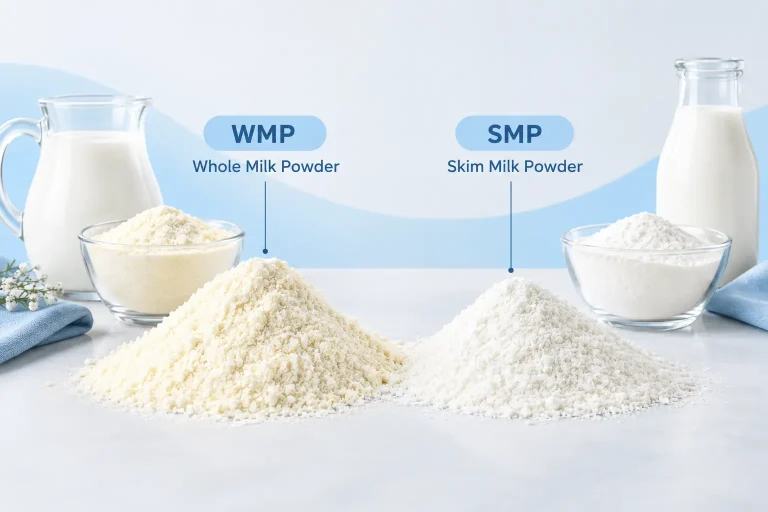
- Skim milk powder (SMP) provides milk solids with much less fat, allowing manufacturers to control dairy solids and fat separately.
- Cream powder can provide a higher concentration of milk fat and a richer dairy profile.
- Milk crumb is used in certain chocolate manufacturing processes to develop distinctive cooked milk and caramelized flavor characteristics.
The right ingredient depends on the product’s fat balance, flavor target, processing equipment and commercial requirements.
For manufacturers seeking a balanced milk chocolate formulation, whole milk powder remains an important ingredient because it delivers multiple milk components in one convenient, shelf-stable form.
Conclusion: The Right Whole Milk Powder Makes a Difference
Whole milk powder is not simply a source of milk flavor in chocolate. Its fat content, free-fat level, lactose state, protein composition and particle structure can all influence how chocolate behaves during manufacturing.
A suitable powder can help manufacturers achieve their desired dairy flavor, manage fat balance and maintain consistent processing performance.
But choosing the right product requires looking beyond a single specification. Total fat content alone does not tell the whole story.
For chocolate manufacturers, the most effective approach is to evaluate whole milk powder according to its complete technical profile and test its performance in the intended formulation.
Wholesale Whole Milk Powder Supply for Chocolate Manufacturers
Shahdoosh, a dairy ingredients brand supplied by Tejarat Chavosh Arian Co., offers Whole Milk Powder for industrial food manufacturers, dairy processors and international buyers.
Contact Tejarat Chavosh Arian Co. directly for wholesale and export inquiries, current pricing, product specifications, batch-specific Certificates of Analysis (COA), packaging details and bulk order arrangements.