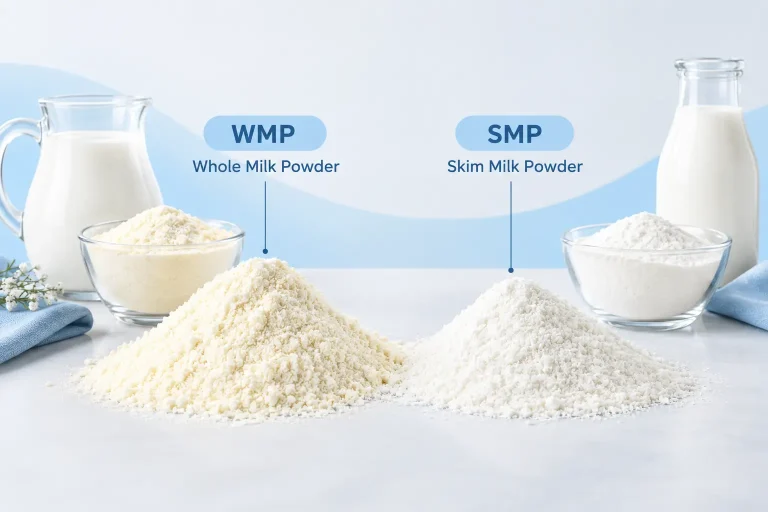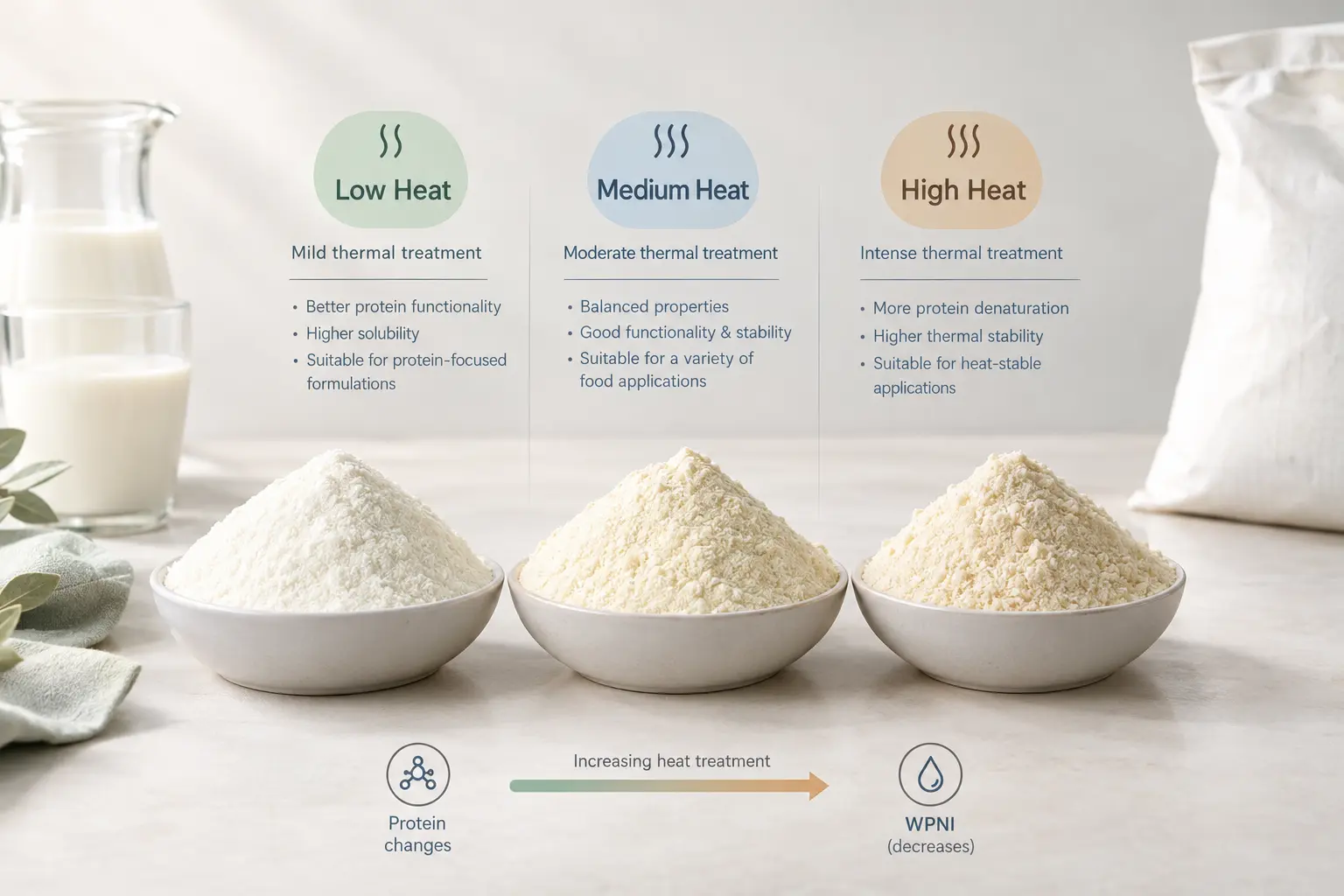
When purchasing industrial milk powder, you may come across terms such as Low Heat, Medium Heat, and High Heat. These terms describe the intensity of heat treatment applied to milk during the manufacturing process and can affect the functional properties of milk proteins, solubility, and the performance of the final product.
But what exactly is the difference between Low Heat, Medium Heat, and High Heat milk powder, and how do you choose the right type for a specific application?
What Do Low Heat, Medium Heat, and High Heat Mean?
Milk goes through several processing stages before it becomes milk powder, including concentration and drying. The amount and intensity of heat applied during processing can affect the structure and functionality of milk proteins.
Based on the severity of heat treatment, milk powder is commonly described as Low Heat, Medium Heat, or High Heat.
In general:
- Low Heat: Mild heat treatment
- Medium Heat: Moderate heat treatment
- High Heat: More intensive heat treatment
These differences are not simply related to the manufacturing process. They can also influence the functional properties of the resulting milk powder.
What Is Low Heat Milk Powder?
Low Heat milk powder is produced using relatively mild heat treatment. The process is designed to limit thermal changes to the milk proteins as much as possible.
Because the proteins undergo less heat-induced modification, Low Heat milk powder is often considered for applications where protein functionality is important.
Depending on its specifications, Low Heat milk powder can be used in a range of food and dairy applications, including products where protein functionality and solubility are important considerations.
What Is Medium Heat Milk Powder?
Medium Heat milk powder is produced using a level of heat treatment between Low Heat and High Heat.
Compared with Low Heat powder, the proteins are exposed to greater thermal treatment, while the treatment is generally less severe than that used for High Heat powder.
This makes Medium Heat milk powder suitable for a variety of food applications where a balance between protein functionality and thermal stability may be required.
The appropriate choice, however, depends on the specifications of the powder and the processing conditions of the final product.
What Is High Heat Milk Powder?
High Heat milk powder is produced using more intensive heat treatment.
Higher heat exposure causes greater changes in milk proteins, particularly whey proteins. This can alter the functional properties of the powder and make it more suitable for applications where greater heat stability is required.
High Heat milk powder may therefore be used in food manufacturing processes where the product is exposed to significant heat during subsequent processing.
What Is WPNI and How Is It Related to Heat Treatment?
One of the indicators used to assess the severity of heat treatment in milk powder is WPNI, or Whey Protein Nitrogen Index.
WPNI measures the amount of undenatured whey protein nitrogen remaining in milk powder and can provide an indication of the degree of heat-induced denaturation of whey proteins.
In general, more intensive heat treatment results in greater whey protein denaturation and, consequently, a lower WPNI value.
For this reason, WPNI can be a useful indicator when evaluating the heat treatment history of milk powder.
However, WPNI should not be used as the sole criterion for selecting milk powder. The intended application, processing conditions, and the complete technical specification of the product should also be considered.
Low Heat vs. Medium Heat vs. High Heat Milk Powder
| Milk Powder Type | Heat Treatment | General Protein Characteristics | Typical Consideration |
|---|---|---|---|
| Low Heat | Mild | Less heat-induced protein modification | Applications where protein functionality is important |
| Medium Heat | Moderate | Intermediate level of heat-induced modification | A wide range of food applications |
| High Heat | Intensive | Greater whey protein denaturation | Applications requiring greater thermal stability |
This comparison provides a general overview. Actual performance depends on the specific product specifications and manufacturing process.
Which Type of Milk Powder Is Best for Food Manufacturing?
There is no single type of milk powder that is universally better than the others.
The appropriate choice depends on the final product formulation and manufacturing process.
For applications where the functional properties of milk proteins are particularly important, Low Heat milk powder may be considered. On the other hand, applications involving significant thermal processing may require a milk powder with greater heat stability, making High Heat an appropriate option in some formulations.
Medium Heat milk powder can be considered when the application requires characteristics between these two processing profiles.
Therefore, milk powder should be selected according to the requirements of the final application rather than simply choosing a product based on its Low Heat, Medium Heat, or High Heat classification.
What Should You Check When Buying Industrial Milk Powder?
For industrial purchasing, asking whether a milk powder is Low Heat or High Heat is not enough.
It is recommended to request the supplier’s Technical Data Sheet (TDS) and review the relevant product specifications, such as:
- Protein content
- Fat content
- Moisture
- Solubility
- WPNI
- Microbiological specifications
- Particle characteristics
- Other application-specific quality parameters
It is also important to clearly communicate the intended application and processing conditions to the supplier.
A milk powder that performs well in one formulation may not provide the same performance in another application.
Conclusion
The terms Low Heat, Medium Heat, and High Heat milk powder primarily describe differences in the severity of heat treatment applied during manufacturing and the resulting changes in milk proteins.
Low Heat milk powder is produced with milder heat treatment and generally undergoes less heat-induced protein modification. Medium Heat falls between the two, while High Heat involves more intensive heat treatment and can provide characteristics suited to applications requiring greater thermal stability.
Indicators such as WPNI can help assess the degree of heat treatment and whey protein denaturation.
For industrial applications, however, the best approach is to evaluate the complete technical specifications of the milk powder together with the formulation and processing conditions of the final product.