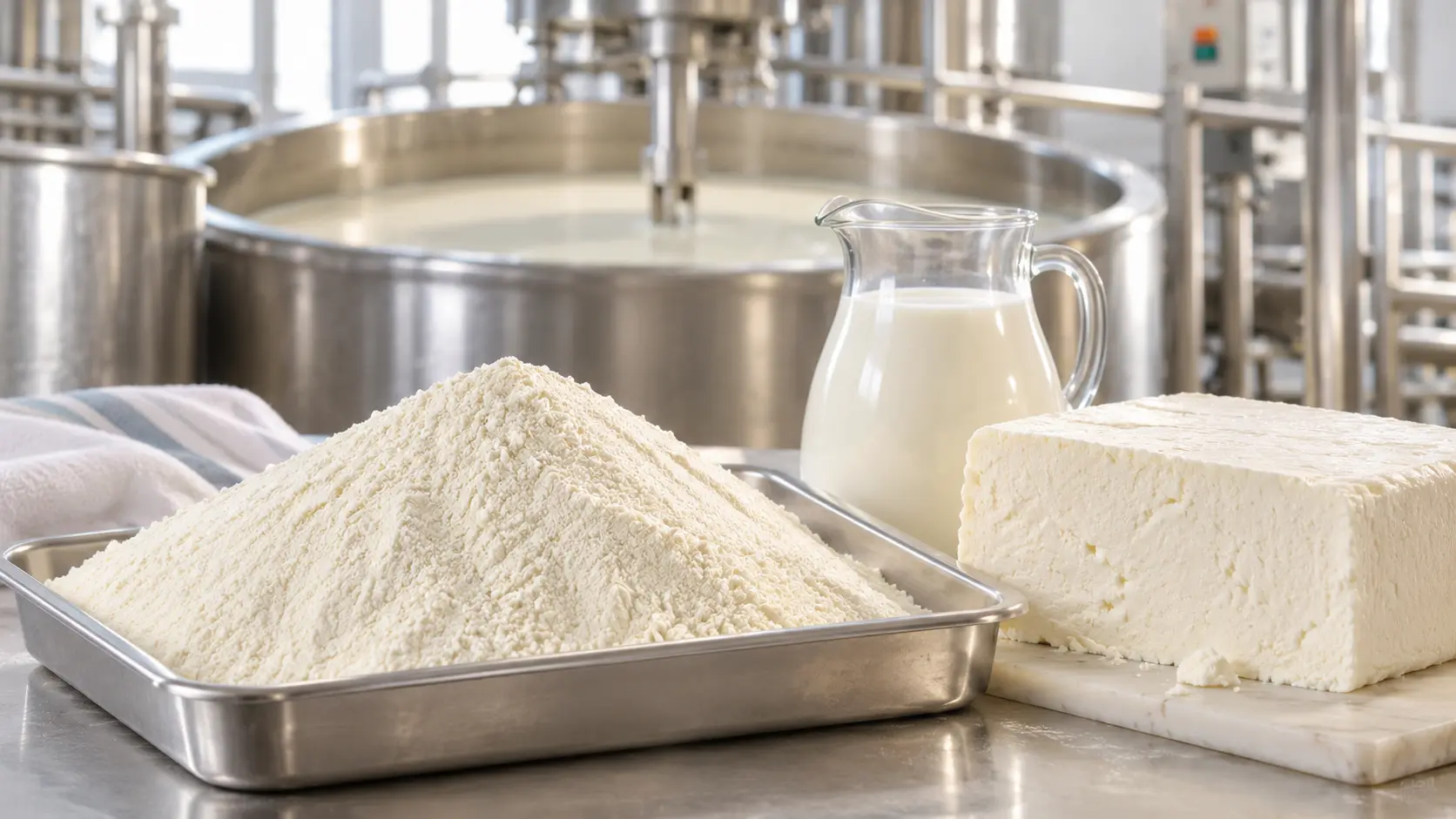
Skim Milk Powder in Cheese Production: Benefits, Cheese Yield, Texture and Industrial Applications
Cheese manufacturing requires precise control over milk composition, particularly protein, fat and total milk solids. Variations in raw milk composition can affect coagulation, curd formation, moisture retention, cheese texture and final production yield. For dairy manufacturers, maintaining consistent milk quality is therefore an essential part of achieving reliable production results.
Skim Milk Powder (SMP) is one of the dairy ingredients used in cheese manufacturing and milk standardization. By supplying milk solids-not-fat (MSNF), including milk proteins, lactose and minerals, SMP can help manufacturers adjust the composition of cheese milk and develop specific formulations for different cheese varieties.
Depending on the cheese type and processing conditions, skim milk powder can also be used to produce recombined milk, partially replace fresh milk or increase the concentration of milk solids in a formulation.
However, its effectiveness depends on several factors, including heat treatment, protein functionality, powder solubility, reconstitution conditions and the cheesemaking process.
This article examines the industrial applications of skim milk powder in cheese production, its influence on cheese yield and texture, the differences between low-heat and high-heat SMP, and the key factors manufacturers should consider when sourcing this dairy ingredient.
What Is Skim Milk Powder?
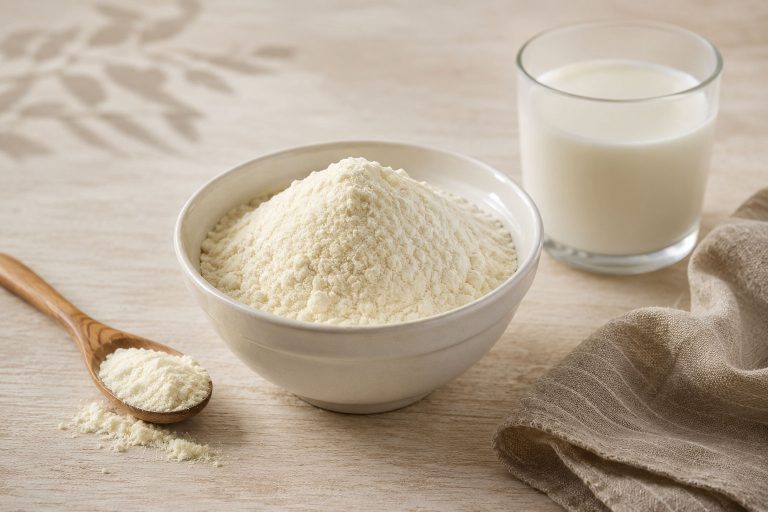
Skim Milk Powder (SMP), also known as non-fat dry milk, is produced by removing most of the fat from milk and subsequently removing its water content through an industrial drying process, typically spray drying.
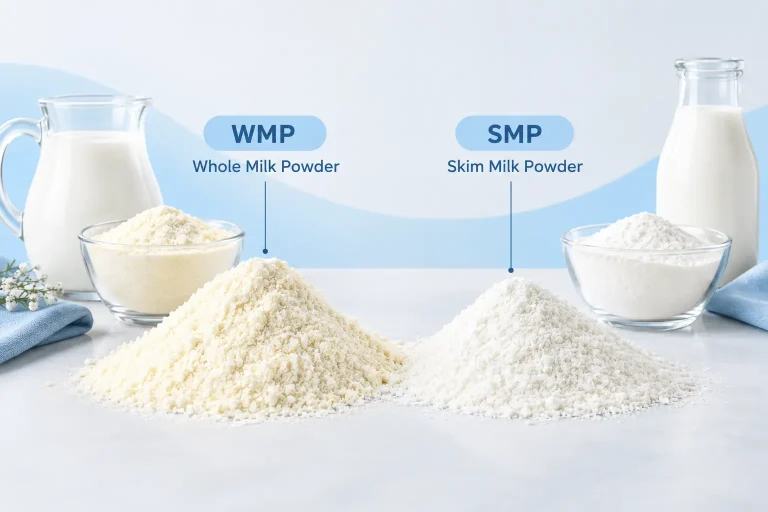
Unlike whole milk powder, skim milk powder contains very little milk fat while retaining most of the non-fat components naturally present in milk.
Its main components include:
- Milk proteins: Primarily casein and whey proteins, which contribute to the structural and functional properties of dairy products.
- Lactose: The naturally occurring milk sugar, which serves as a fermentable carbohydrate for lactic acid bacteria.
- Minerals: Including calcium and phosphorus, which influence milk mineral balance and protein coagulation.
- Moisture: Residual water content, which is controlled to maintain product stability and shelf life.
Under the Codex Standard for Milk Powders (CXS 207-1999), skimmed milk powder must contain no more than 1.5% milk fat and 5% moisture. Its milk protein content must be at least 34% of milk solids-not-fat (MSNF).
These specifications make SMP a widely used ingredient in the dairy and food processing industries.
Why Is Skim Milk Powder Used in Cheese Manufacturing?
The composition of raw milk is not always consistent. Seasonal variations, animal nutrition, breed and farm management practices can influence its protein and fat content.
These variations may affect the cheesemaking process and create differences in the composition and quality of the final product.
Milk standardization is an important industrial practice used to control these variations. It involves adjusting the composition of milk to meet the specific requirements of a particular cheese variety.
Skim milk powder can be incorporated into this process to increase milk solids-not-fat and adjust the protein concentration of the cheese milk.
The main reasons for using SMP in cheese manufacturing include the following.
1. Increasing Milk Solids and Adjusting Protein Content
Milk protein plays a central role in cheese production. Casein, in particular, forms the primary protein network of most conventional rennet-coagulated cheeses.
This network traps fat and moisture during curd formation and contributes to the structure and texture of the finished cheese.
Adding skim milk powder to a suitable milk formulation can increase its total solids and protein concentration.
However, it is important to distinguish between total milk protein and casein. SMP contains both casein and whey proteins, and these proteins behave differently during coagulation and whey separation.
For this reason, manufacturers should evaluate the casein-to-fat ratio and the functional properties of the milk proteins rather than relying exclusively on total protein content.
2. Improving Cheese Yield Under Controlled Conditions
Cheese yield refers to the quantity of cheese obtained from a given amount of milk.
It is influenced by several factors, including:
- Casein and total protein concentration
- Milk fat content
- Moisture content of the finished cheese
- Fat and protein retention in the curd
- Coagulation efficiency
- Whey drainage and processing conditions
Increasing the concentration of milk solids through SMP addition can help improve the amount of cheese obtained under suitable processing conditions.
The additional milk protein and solids may contribute to curd formation and the composition of the final product.
However, higher milk solids do not automatically guarantee higher economic cheese yield. The additional proteins must be retained effectively in the curd, and the resulting cheese must meet the required moisture, texture and quality specifications.
Manufacturers should therefore evaluate cheese yield through controlled production trials rather than assuming that increasing the SMP addition rate will always improve production efficiency.
3. Improving Consistency in Cheese Manufacturing
Consistency is a major requirement in commercial cheese production.
Variations in the composition of incoming milk can lead to differences in coagulation behavior, curd firmness, moisture retention and final cheese composition.
Using skim milk powder as part of a controlled milk standardization or recombination process can help manufacturers achieve a more consistent formulation.
This is particularly relevant for industrial facilities that require stable product specifications across different production batches.
4. Producing Recombined Milk for Cheese Applications
Skim milk powder can be reconstituted with water to produce skim milk, which may then be combined with milk fat or other dairy ingredients to prepare recombined milk.
Recombined milk can be used in certain cheese manufacturing systems, particularly where fresh milk availability, transportation costs or raw material supply conditions make this approach commercially attractive.
The suitability of recombined milk depends on the cheese variety and the manufacturing technology.
Fresh and soft cheeses can generally be produced using recombined milk under appropriately controlled conditions. Some stretched-curd and specialty cheeses, however, require additional process adjustments to achieve the desired functional properties.
How Does Skim Milk Powder Affect Cheese Texture and Quality?
The influence of SMP on cheese texture depends on its composition, heat classification, reconstitution quality and the type of cheese being manufactured.
Changes in milk protein concentration and protein functionality can influence the structure of the curd and the way water is retained within the cheese matrix.
Some of the most important characteristics include:
Protein Network Structure
Casein forms the primary structural network in most rennet-coagulated cheeses. The concentration and functional properties of milk proteins influence curd formation and the mechanical properties of the finished cheese.
Moisture Retention
The relationship between milk solids, curd formation and whey drainage determines how much moisture remains in the cheese. Changes in milk composition can affect water retention, but the outcome depends on the entire manufacturing process.
Cheese Firmness and Texture
Adjustments in protein and fat composition can influence firmness, elasticity and overall texture. Excessive changes in milk solids may produce undesirable textural characteristics if the formulation is not properly optimized.
Melting and Stretching Properties
In cheeses such as Mozzarella, the functionality of the protein network is particularly important. Milk powder characteristics and recombination conditions can influence stretching, melting and moisture distribution.
A 2021 study published in LWT – Food Science and Technology investigated the partial replacement of fresh milk with reconstituted low-heat skim milk powder in high-moisture Mozzarella production.
The researchers reported comparable cheese composition and yield between the fresh-milk and recombined-milk treatments, while also observing differences in protein network organization and water distribution.
These findings demonstrate that properly selected SMP can be used in certain industrial cheese formulations, although process optimization remains essential.
Which Type of Skim Milk Powder Is Best for Cheese Production?
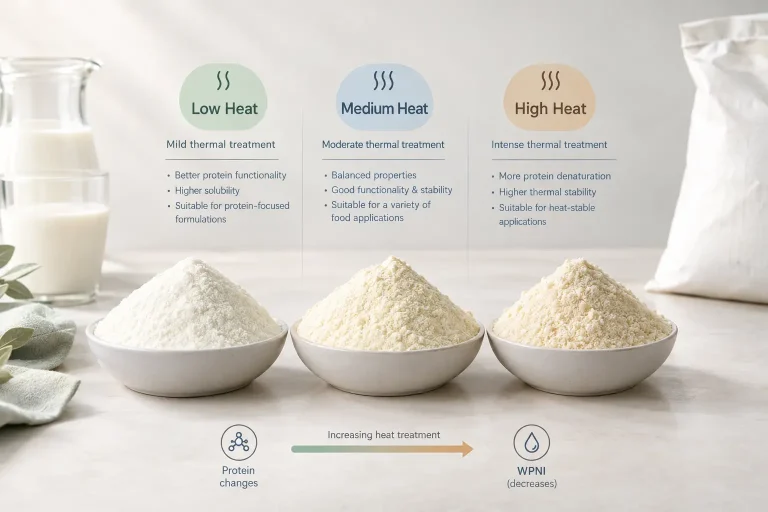
Skim milk powder is commonly classified according to the intensity of heat treatment applied to the milk before drying.
The three main classifications are:
- Low Heat Skim Milk Powder
- Medium Heat Skim Milk Powder
- High Heat Skim Milk Powder
Heat treatment influences the degree of whey protein denaturation and, consequently, the functional properties of the powder.
One important measurement used to classify SMP is the Whey Protein Nitrogen Index (WPNI).
WPNI indicates the amount of undenatured whey protein nitrogen remaining in the powder and provides information about the heat treatment applied during manufacturing.
Low Heat Skim Milk Powder
Low Heat SMP undergoes relatively mild heat treatment before drying.
As a result, a greater proportion of its whey proteins remains in an undenatured state.
Under commonly used WPNI classifications, Low Heat SMP has a WPNI of at least 6 mg/g.
This type of powder is particularly relevant to milk standardization and recombined milk applications where the functionality of milk proteins is important.
Low Heat SMP is commonly preferred for many conventional cheese manufacturing applications, especially those involving rennet coagulation.
Its suitability should still be assessed according to the specific cheese variety and processing conditions.
Medium Heat Skim Milk Powder
Medium Heat SMP receives a more intensive heat treatment than Low Heat SMP.
Its WPNI generally falls between 1.5 and 6 mg/g.
During processing, a greater proportion of whey proteins becomes denatured, which can influence water absorption, viscosity and other functional properties.
Medium Heat SMP is widely used in different food and dairy applications, including bakery products, confectionery and selected dairy formulations.
It may also be suitable for certain cheese applications, depending on the manufacturing process and the desired product characteristics.
High Heat Skim Milk Powder
High Heat SMP undergoes more intensive heat treatment before drying, resulting in a higher degree of whey protein denaturation.
Its WPNI is generally below 1.5 mg/g.
This type of powder is commonly selected for applications where specific heat-related functional properties are required, including certain bakery and processed food formulations.
However, High Heat SMP is not usually the first choice for conventional rennet-coagulated cheese milk standardization, because extensive whey protein denaturation can affect coagulation behavior.
The appropriate heat classification should always be selected according to the intended application and the technical requirements of the cheese production process.
How Is Skim Milk Powder Used in the Cheese Manufacturing Process?
The use of SMP in industrial cheesemaking requires careful control of powder reconstitution, milk composition and processing conditions.
The exact procedure varies according to the type of cheese, equipment and manufacturing technology.
The general process includes the following stages.
1. Selecting the Appropriate Milk Powder
The first step is selecting an SMP specification that matches the intended cheese application.
Important factors include:
- Protein content
- Heat classification
- WPNI value
- Solubility and dispersibility
- Microbiological quality
- Moisture content
- Functional performance during coagulation
Low Heat SMP is often a suitable starting point for conventional cheese milk standardization, although application-specific trials are necessary.
2. Reconstitution of Skim Milk Powder
The powder is mixed with suitable potable water under controlled conditions to produce reconstituted skim milk.
Proper mixing is essential to achieve uniform dispersion and minimize undissolved particles or powder agglomerates.
The temperature, mixing intensity and hydration time should be adjusted according to the powder specification and production system.
3. Milk Composition Standardization
After reconstitution, the milk formulation is adjusted according to the requirements of the target cheese.
This may involve controlling:
- Total solids
- Protein concentration
- Fat content
- Casein-to-fat ratio
- Mineral balance
The objective is to establish a consistent milk composition before the coagulation stage.
4. Heat Treatment and Milk Preparation
The milk undergoes the appropriate heat treatment and preparation steps required for the cheese variety.
Excessive heat treatment may cause additional whey protein denaturation and influence rennet coagulation.
Therefore, the temperature and holding time must be selected carefully.
5. Coagulation and Curd Formation
Depending on the cheese variety, coagulation may involve starter cultures, lactic acid fermentation, rennet enzymes or a combination of these methods.
The control of pH, temperature and coagulation time is essential for achieving the required curd characteristics.
6. Whey Separation and Cheese Formation
After coagulation, the curd is cut and processed according to the specific cheese manufacturing method.
Whey drainage, curd handling, pressing and shaping determine important characteristics of the finished product.
The retention of fat and protein in the curd is particularly important for achieving efficient cheese production.
7. Final Product Quality Evaluation
The finished cheese should be evaluated for:
- Moisture content
- Protein and fat composition
- Texture and firmness
- Sensory characteristics
- Melting or stretching properties, where applicable
- Production yield
Comparing these results with a fresh-milk control batch can help manufacturers determine the actual performance of SMP in their formulation.
What Should Manufacturers Consider When Buying Skim Milk Powder for Cheese Production?
Selecting the right skim milk powder requires more than comparing prices or checking the protein percentage on the product specification sheet.
Industrial buyers should evaluate the technical characteristics of the powder against the requirements of their manufacturing process.
The following factors are particularly important.
1. Protein Content
Protein content is an important indicator of the powder’s nutritional and functional composition. Buyers should check whether the declared protein specification meets the requirements of their formulation.
2. Heat Classification
Low Heat, Medium Heat and High Heat SMP have different functional properties. The correct classification should be selected according to the intended cheese application.
3. Whey Protein Nitrogen Index (WPNI)
WPNI provides information about the degree of whey protein denaturation and helps manufacturers evaluate the heat treatment history of the powder.
4. Solubility and Reconstitution Performance
Good reconstitution performance is important for preparing uniform milk formulations and maintaining consistent production conditions.
5. Microbiological Quality
Microbiological specifications should meet the applicable food safety requirements and the manufacturer’s internal quality standards.
6. Moisture Content and Storage Stability
Moisture control and suitable packaging help maintain product quality during transportation and storage.
7. Certificate of Analysis (COA)
A Certificate of Analysis provides batch-specific information about the product’s composition and quality parameters. Industrial buyers should request and review this documentation before purchasing.
In addition to reviewing technical documents, manufacturers should conduct laboratory or pilot-scale trials before introducing a new powder specification into full-scale production.
Does Adding Skim Milk Powder Always Increase Cheese Yield?
No. Increasing the amount of skim milk powder in a formulation does not automatically result in higher cheese yield.
Although SMP can increase the concentration of milk solids and proteins, the actual yield depends on how effectively these components are incorporated into the curd.
Several factors influence the outcome:
- The initial composition of the milk
- The casein-to-fat ratio
- Protein functionality
- Coagulation efficiency
- Whey drainage conditions
- Final cheese moisture content
- Processing losses
For example, if a significant proportion of additional protein is lost in the whey, the expected improvement in cheese yield may not be achieved.
Similarly, excessive milk solids can alter cheese firmness, moisture distribution and melting characteristics.
The most effective approach is to determine the appropriate SMP addition rate through formulation calculations, controlled trials and final product evaluation.
Skim Milk Powder vs. Milk Protein Concentrate (MPC) in Cheese Manufacturing
Skim milk powder and Milk Protein Concentrate (MPC) are both dairy ingredients used in industrial food formulations. However, they differ significantly in composition and functionality.
SMP contains milk proteins, lactose and minerals in proportions broadly reflecting those found in skim milk.
MPC is produced through membrane filtration processes that concentrate milk proteins while retaining different proportions of other milk components, depending on the product specification.
As a result, MPC generally provides a higher protein concentration than conventional SMP.
The choice between these ingredients depends on the manufacturer’s formulation objectives.
Skim Milk Powder may be preferred when:
- Additional milk solids-not-fat are required.
- A cost-effective ingredient for milk standardization is needed.
- Reconstituted milk is part of the manufacturing process.
- Protein, lactose and mineral contributions are all relevant to the formulation.
Milk Protein Concentrate may be considered when:
- A higher protein concentration is required.
- Protein levels need to be adjusted more selectively.
- The formulation requires a different protein-to-lactose ratio.
Neither ingredient is universally superior. The right choice depends on the cheese variety, target composition, processing technology and overall production economics.
Conclusion: Choosing the Right Skim Milk Powder for Industrial Cheese Production
Skim Milk Powder is a valuable dairy ingredient for manufacturers looking to control milk composition and develop consistent cheese formulations.
Its applications include milk standardization, recombined milk production and the adjustment of milk solids in selected cheese manufacturing processes.
When properly selected and used, SMP can help manufacturers manage protein concentration, improve formulation consistency and optimize production performance.
However, achieving the desired results requires attention to heat classification, WPNI, solubility, protein functionality and processing conditions.
For industrial dairy manufacturers, selecting the right SMP specification is an important step toward maintaining product quality and production efficiency.
Frequently Asked Questions About Skim Milk Powder in Cheese Production
Can skim milk powder replace fresh milk in cheese manufacturing?
In certain industrial processes, reconstituted skim milk can partially or, for selected cheese varieties, substantially replace fresh skim milk. The feasibility depends on the cheese type, formulation, powder characteristics and manufacturing technology. Full replacement is not suitable for every cheese variety.
Which type of skim milk powder is best for cheese production?
Low Heat SMP is commonly preferred for conventional rennet-coagulated cheese applications because it retains a higher proportion of undenatured whey proteins. However, the best choice depends on the specific cheese formulation and processing conditions.
Does skim milk powder increase cheese protein content?
Adding SMP can increase the protein and total solids concentration of cheese milk. The final protein content of the cheese depends on protein retention in the curd and the amount of protein lost during whey separation.
Does skim milk powder affect Mozzarella cheese quality?
Yes. Milk protein functionality, powder heat classification and reconstitution conditions can influence the structure, moisture distribution, stretching and melting properties of Mozzarella.
What is the difference between Low Heat and High Heat skim milk powder?
The main difference is the intensity of heat treatment applied before drying. Low Heat SMP retains a higher level of undenatured whey proteins, while High Heat SMP contains a greater proportion of denatured whey proteins. These differences influence their functional properties and suitability for different food applications.
Is skim milk powder suitable for low-fat cheese production?
Yes. SMP can be used in certain low-fat cheese formulations to increase milk solids and adjust protein concentration. However, additional formulation adjustments may be necessary to achieve the desired texture, moisture and sensory characteristics.
Buy Skim Milk Powder from Shahdoosh – Direct Supply and Export Inquiries
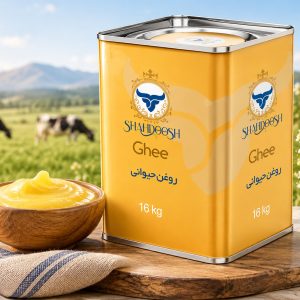
Shahdoosh, a dairy ingredients brand supplied by Tejarat Chavosh Aryan Co., offers Skim Milk Powder (SMP) for industrial food manufacturers, dairy processors and international buyers.
Whether you are a cheese manufacturer looking for a reliable source of skim milk powder or an importer seeking dairy ingredients for your local market, our sales team is ready to assist with your sourcing requirements.
Contact Tejarat Chavosh Aryan Co. directly for wholesale and export inquiries, current pricing, product specifications, batch-specific Certificates of Analysis (COA), packaging details and bulk order arrangements.
For international buyers, our team can provide further information to help evaluate product suitability and discuss export supply requirements according to the destination market.
Contact us today to request a quotation and discuss your Skim Milk Powder purchasing requirements.