Instant vs. Non-Instant Milk Powders: Differences, Production Process, Functional Properties, and Industrial Applications
Milk powder is one of the most widely traded dairy ingredients in the world. It offers long shelf life, easy transportation, and broad functionality across food industries. However, not all milk powders behave the same way. One of the most important distinctions in the dairy sector is between instant milk powder and non-instant (regular) milk powder.
Although both products may have similar nutritional compositions, their physical properties, processing methods, and end-use performance differ significantly. Understanding these differences is essential for food manufacturers, traders, and even consumers who rely on milk powder for specific applications.
This article explores the differences between instant and non-instant milk powders, how they are produced, their functional characteristics, and where each type performs best.
1. What Is Milk Powder?
Milk powder is produced by removing most of the water from liquid milk through evaporation and spray drying. The result is a dry, shelf-stable dairy product that retains proteins, lactose, minerals, and (depending on the type) fat.
The most common types include:
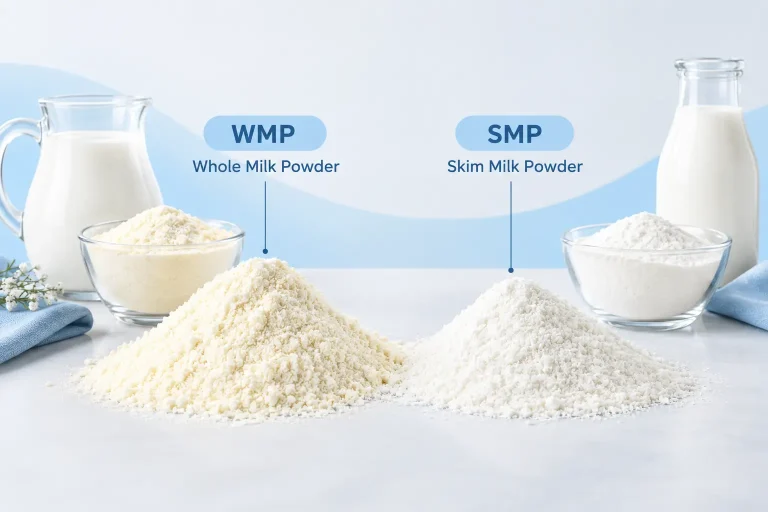
- Whole Milk Powder (WMP)
- Skim Milk Powder (SMP)
- Dairy Whitener
- Fortified Milk Powder
Both instant and non-instant versions can be made from whole or skim milk.
2. What Is Non-Instant Milk Powder?
Non-instant milk powder, sometimes referred to as regular milk powder, is produced through standard spray drying without additional agglomeration or surface treatment.
Key Characteristics:
- Fine, uniform particles
- Higher bulk density
- Slower wettability
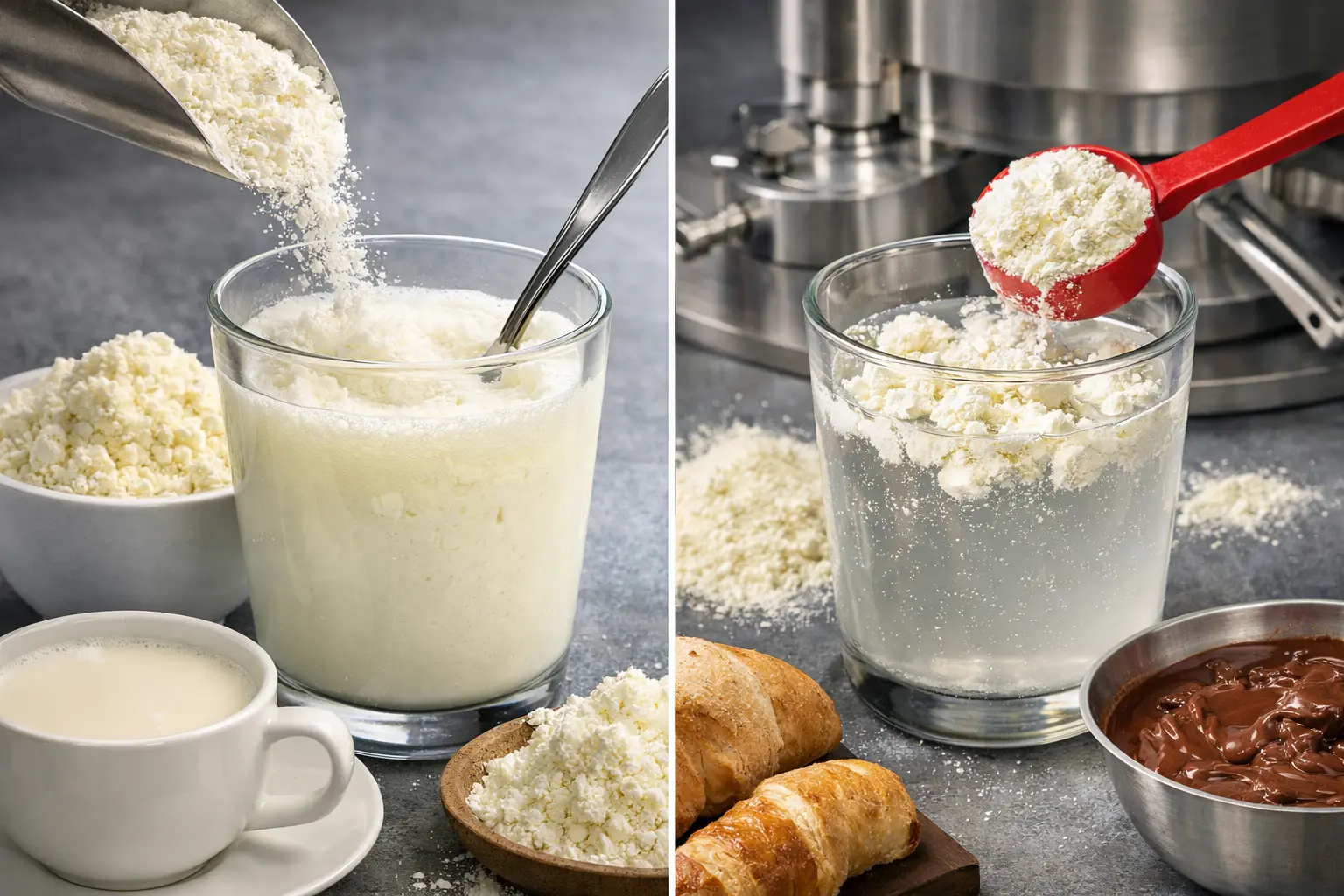
- May form lumps when mixed directly with cold water
Because the particles are small and dense, they tend to float on water initially. As a result, they require stronger mixing, warm water, or mechanical agitation for proper dissolution.
Non-instant milk powder is widely used in industrial applications where mechanical mixing systems are available.
3. What Is Instant Milk Powder?
Instant milk powder undergoes an additional processing step known as agglomeration. During this stage, small powder particles are combined into larger, porous clusters.
Key Characteristics:
- Larger, porous particles
- Lower bulk density
- Rapid wettability
- Easy dispersion in cold water
- Minimal lump formation
Thanks to its porous structure, water penetrates instant powder more easily. Therefore, it dissolves quickly with simple stirring, even in cold water.
Instant milk powder is primarily designed for direct consumer use and quick reconstitution.
4. Production Process Differences
Although both types begin with evaporation and spray drying, the difference lies in the post-drying stage.
4.1 Standard Spray Drying (Non-Instant)
The typical process includes:
- Milk standardization
- Pasteurization
- Evaporation to concentrate solids
- Spray drying
After drying, the powder is cooled and packaged.
The final product contains fine particles with relatively smooth surfaces.
4.2 Agglomeration Process (Instant)
In addition to the standard steps, instant milk powder includes:
- Rewetting of fine powder particles
- Agglomeration in a fluidized bed
- Re-drying
- Cooling and packaging
During agglomeration, moisture is lightly sprayed onto powder particles, causing them to stick together. Airflow then forms porous clusters. This structure improves reconstitution properties dramatically.
5. Functional Properties Comparison
| Property | Instant Milk Powder | Non-Instant Milk Powder |
|---|---|---|
| Particle Size | Larger, porous | Fine, compact |
| Bulk Density | Lower | Higher |
| Wettability | Excellent | Moderate to slow |
| Dispersibility | High | Lower |
| Solubility | Fast in cold water | May require warm water |
| Consumer Use | Ideal | Less convenient |
5.1 Wettability
Wettability refers to how quickly powder absorbs water. Instant powders excel in this area because their porous structure allows water penetration.
5.2 Dispersibility
Instant milk powder disperses evenly without forming clumps. In contrast, non-instant powder may float and require vigorous stirring.
5.3 Flowability
Instant powder often has better flow in packaging lines due to particle size distribution. However, non-instant powder may have slightly better storage density due to its compact structure.
6. Applications in the Food Industry
6.1 Applications of Instant Milk Powder
- Household reconstituted milk
- Vending machines
- Coffee and tea whitening
- Emergency food supply
- Institutional catering
Because it dissolves easily, it is ideal for consumer convenience.
6.2 Applications of Non-Instant Milk Powder
- Chocolate manufacturing
- Bakery products
- Ice cream production
- Processed cheese
- Yogurt production
- Recombined dairy beverages (industrial scale)
In factories, high-speed mixers eliminate dissolution concerns. Therefore, non-instant powder is often more economical for industrial use.
7. Nutritional Differences
From a nutritional standpoint, instant and non-instant milk powders are almost identical.
Both contain:
- Milk proteins (casein and whey)
- Lactose
- Calcium
- Vitamins (if fortified)
- Milk fat (in whole milk powder)
The agglomeration process does not significantly alter nutritional composition.
Therefore, the difference is primarily physical and functional—not nutritional.
8. Shelf Life and Storage
Both instant and non-instant milk powders:
- Require storage below 25°C
- Must be kept in low humidity environments
- Should be protected from light and oxygen
Shelf life typically ranges from 12 to 24 months depending on fat content and packaging.
Whole milk powder is more sensitive to oxidation due to fat content, while skim milk powder is generally more stable.
9. Economic Considerations
Instant milk powder usually costs slightly more because:
- It involves additional processing steps
- It consumes more energy
- It requires specialized equipment
However, the improved consumer convenience often justifies the higher price.
Non-instant milk powder, on the other hand, offers better cost-efficiency for bulk industrial buyers.
10. Advantages and Disadvantages
Instant Milk Powder
Advantages:
- Quick dissolution
- Easy consumer preparation
- Better dispersibility
Disadvantages:
- Slightly higher cost
- Lower bulk density (larger packaging volume)
Non-Instant Milk Powder
Advantages:
- More economical
- Higher bulk density
- Suitable for industrial mixing
Disadvantages:
- Slower dissolution
- May form lumps in cold water
11. Which One Should You Choose?
The choice depends entirely on application.
- For retail markets and direct consumer use → Instant milk powder is preferable.
- For industrial processing with mechanical mixing → Non-instant milk powder is more cost-effective.
Food manufacturers must evaluate:
- Mixing systems available
- Reconstitution requirements
- Cost sensitivity
- Packaging format
- End-product texture and functionality
12. Quality Control Parameters
Regardless of type, quality assessment includes:
- Moisture content
- Insolubility index
- Bulk density
- Scorched particle content
- Microbiological safety
- Sensory evaluation
For instant powder, wettability and dispersibility tests are particularly critical.
13. Global Market Trends
In developing markets, instant milk powder demand is rising due to:
- Increased consumer convenience
- Growth in ready-to-drink beverages
- Expansion of e-commerce grocery sales
Meanwhile, non-instant milk powder remains dominant in:
- Industrial dairy processing
- Confectionery manufacturing
- Large-scale food production
As consumer lifestyles evolve, instant formats are gaining popularity. However, industrial demand for non-instant powder continues to drive global dairy trade volumes.
14. Final Conclusion
Instant and non-instant milk powders may originate from the same raw material, yet they serve different functional and commercial purposes.
Instant milk powder offers superior wettability, rapid dispersion, and convenience for direct consumption. In contrast, non-instant milk powder provides economic advantages and high-density storage for industrial applications.
Ultimately, the difference lies not in nutritional value but in structure and functionality. Selecting the appropriate type ensures optimal product performance, cost efficiency, and consumer satisfaction.
In the modern dairy industry, understanding these distinctions is essential for manufacturers, traders, and quality managers seeking competitive advantage in both domestic and international markets.