Protein Functionality in Dairy Ingredients
Foaming, Emulsification, and Water Binding Explained
Understanding the Real Role of Dairy Proteins in Industrial Food Formulation
In industrial food formulation, dairy proteins are far more than nutritional components. They are functional building blocks that directly influence texture, stability, mouthfeel, processing behavior, and final product quality. When used correctly, dairy proteins enable manufacturers to control foam structure, stabilize emulsions, and manage water efficiently across a wide range of food and beverage applications.
However, many formulation challenges arise not from ingredient quality, but from misunderstanding how dairy proteins actually behave in real systems. Simply adding protein does not guarantee performance. Instead, functionality depends on protein type, processing history, heat treatment, and interaction with other ingredients.
This article provides a practical and application-oriented explanation of protein functionality in dairy ingredients, with a clear focus on foaming, emulsification, and water binding. Rather than theoretical chemistry, the emphasis is on how these functions work in industrial conditions—and how to use them effectively.
What Is Protein Functionality in Dairy Systems?
Protein functionality refers to the ability of proteins to perform specific physical and chemical roles in a food system beyond nutrition. In dairy-based ingredients, functionality is closely linked to protein structure and behavior at interfaces such as air–water, oil–water, and protein–water boundaries.
In practice, functional properties determine whether a product:
- Holds its structure over time
- Separates or remains stable
- Feels creamy or thin
- Performs consistently during processing
Among the most important functional roles of dairy proteins are foaming, emulsification, and water binding.
Key Dairy Protein Sources Used for Functionality
Before examining specific functions, it is important to understand the main protein sources used in dairy-based formulations.
Casein and Caseinates
Caseins are flexible, surface-active proteins that perform exceptionally well in emulsification and water binding. Sodium and calcium caseinates are widely used in processed foods, sauces, coffee creamers, and recombined dairy systems.
Whey Proteins
Whey proteins, including whey protein concentrate (WPC) and isolate (WPI), are globular proteins with strong foaming properties. They are commonly used in beverages, desserts, whipped products, and nutritional formulations.
Milk Proteins (Combined Systems)
Milk protein concentrates (MPC) and milk powders contain both casein and whey proteins, offering balanced functionality when properly processed.
Each protein type contributes differently to foam formation, emulsion stability, and moisture control.
Foaming Functionality: Creating and Stabilizing Air
What Is Foaming in Food Systems?
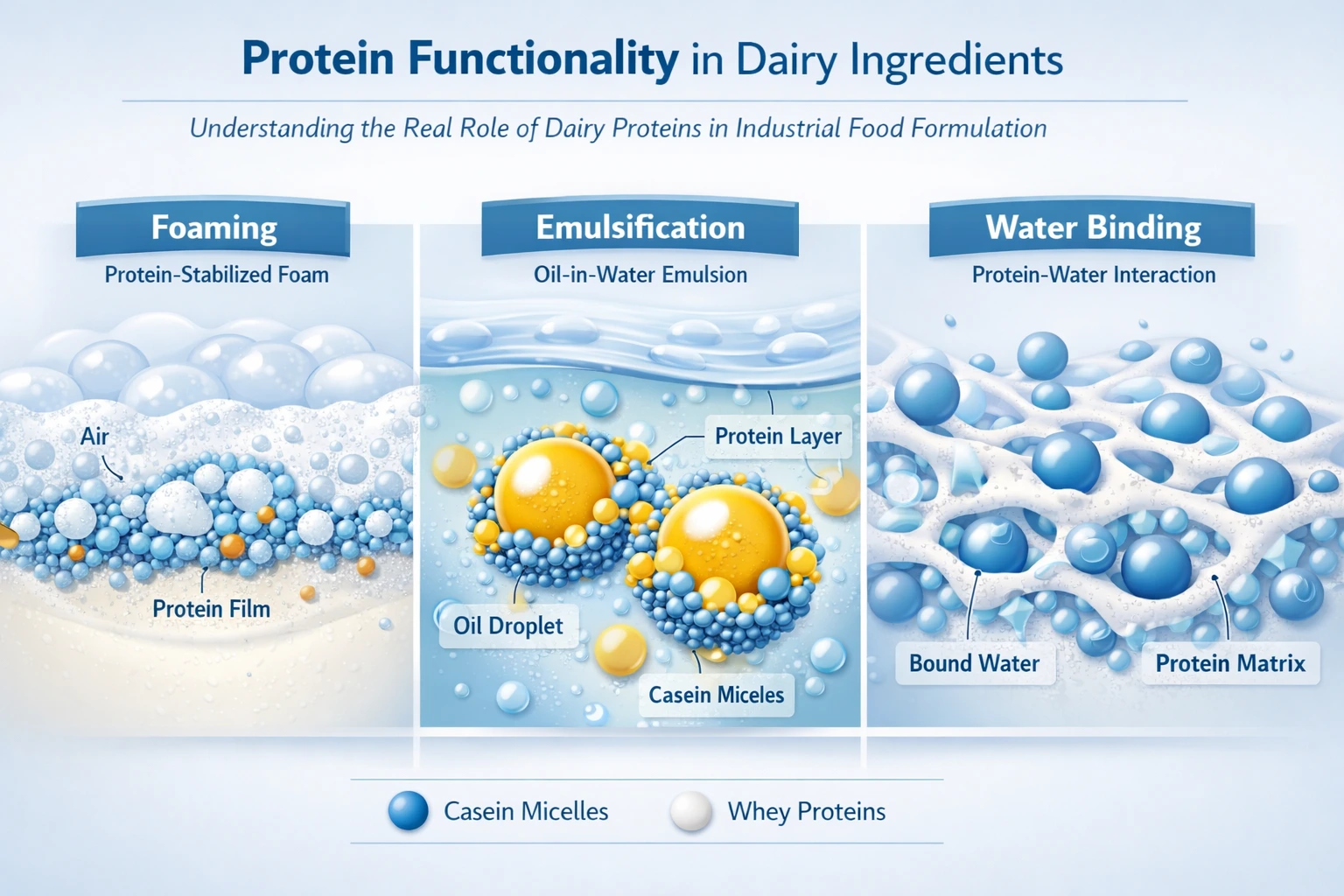
Foaming occurs when air is incorporated into a liquid or semi-liquid system and stabilized by surface-active components—primarily proteins. The protein forms a thin film around air bubbles, preventing them from collapsing.
Foaming is critical in products such as:
- Whipped desserts
- Ice cream
- Cappuccino foam
- Bakery batters
- Aerated dairy snacks
Why Whey Proteins Excel at Foaming
Whey proteins are particularly effective at foaming because they rapidly migrate to the air–water interface and unfold to form elastic films. This behavior allows them to trap air efficiently during whipping or agitation.
As a result, whey proteins offer:
- High foam volume
- Fine bubble structure
- Rapid foam formation
However, foam stability depends heavily on heat treatment and formulation conditions.
Foam Stability vs Foam Volume
While whey proteins generate high foam volume, caseins contribute to longer-term foam stability. In many formulations, blending whey proteins with caseinates improves both foam expansion and resistance to collapse.
Therefore, successful foam systems often rely on protein synergy, not a single protein source.
Emulsification: Stabilizing Oil and Water
Understanding Emulsification in Dairy Formulation
Emulsification is the process of stabilizing oil droplets within a water-based system. In dairy formulations, proteins act as natural emulsifiers by adsorbing to the oil–water interface and reducing surface tension.
Emulsification is essential in products such as:
- Coffee creamers
- Dairy beverages
- Sauces and dressings
- Ice cream mixes
- Processed cheese
Caseins as Natural Emulsifiers
Caseins are particularly effective emulsifiers due to their flexible structure and strong surface activity. Unlike globular proteins, caseins do not require unfolding before interacting with fat droplets.
Because of this, casein-based systems provide:
- Strong emulsion stability
- Resistance to heat and shear
- Consistent mouthfeel
This makes caseinates a preferred choice in coffee whiteners and UHT beverages.
Whey Proteins in Emulsions
Whey proteins can also act as emulsifiers, but their performance is more sensitive to processing conditions. Heat-denatured whey proteins may lose emulsifying efficiency, especially in acidic systems.
Consequently, whey proteins are often used alongside stabilizers or casein-based proteins to ensure long-term emulsion stability.
Water Binding: Managing Moisture and Texture
Why Water Binding Matters
Water binding refers to the ability of proteins to absorb, retain, and control water within a food matrix. This property directly influences texture, yield, shelf life, and processing efficiency.
Effective water binding is critical in:
- Yogurt and fermented dairy
- Cheese analogues
- Bakery fillings
- Meat and dairy hybrid products
- Processed foods
Casein Dominance in Water Binding
Caseins exhibit strong water-binding capacity due to their open, flexible structure. They trap water within the protein network, preventing syneresis (water release) during storage.
As a result, casein-based ingredients help:
- Improve creaminess
- Reduce product shrinkage
- Enhance freeze–thaw stability
- Maintain consistent texture
Whey Proteins and Water Interaction
Whey proteins bind less water than caseins in their native form. However, after controlled heat denaturation, whey proteins can form gel networks that retain water effectively.
This behavior is especially useful in:
- High-protein beverages
- Heat-set desserts
- Protein-enriched dairy products
Impact of Heat Treatment on Protein Functionality
Heat treatment plays a decisive role in protein behavior. Spray drying, UHT processing, and pasteurization all influence how proteins perform in formulation.
- Low-heat proteins retain native functionality and solubility
- Medium-heat proteins offer balanced performance
- High-heat proteins show reduced solubility but enhanced water binding
Selecting the correct heat treatment level is therefore essential for achieving the desired functional outcome.
Protein Interactions in Complex Formulations
In real food systems, proteins rarely act alone. They interact with:
- Fats
- Carbohydrates
- Minerals
- Stabilizers and emulsifiers
These interactions can either enhance or inhibit protein functionality. For example:
- Lactose may improve protein hydration
- Excess minerals can reduce solubility
- Fat content alters foam and emulsion behavior
Understanding these interactions allows formulators to design more robust and predictable systems.
Application Examples Across Industries
Coffee and RTD Beverages
Casein-based proteins provide emulsion stability, while whey proteins contribute foam in hot applications. Blended systems often deliver the best performance.
Bakery and Desserts
Whey proteins support aeration and volume, whereas caseins improve moisture retention and softness.
Ice Cream and Frozen Desserts
Balanced protein systems enhance overrun, control ice crystal growth, and stabilize fat emulsions.
Nutritional and Functional Foods
Whey proteins dominate for protein claims, while caseins contribute texture and satiety.
Common Mistakes in Using Dairy Proteins
Despite their versatility, dairy proteins are often misused. Common mistakes include:
- Selecting protein based only on protein percentage
- Ignoring heat treatment specifications
- Overloading systems with protein without functional need
- Using whey proteins where caseins are required for stability
Avoiding these errors reduces formulation failures and production losses.
Strategic Value of Understanding Protein Functionality
Manufacturers who understand protein functionality gain several advantages:
- Improved product consistency
- Reduced need for corrective additives
- Better cost control
- Faster product development cycles
In competitive markets, functional knowledge becomes a strategic asset rather than a technical detail.
Final Thoughts
Dairy proteins are powerful functional tools when used with purpose and understanding. Foaming, emulsification, and water binding are not abstract properties—they are practical mechanisms that define product performance.
By selecting the right protein source, managing processing conditions, and respecting protein interactions, formulators can unlock the full potential of dairy ingredients.
In modern food manufacturing, success does not come from adding more ingredients—but from using the right ones correctly.